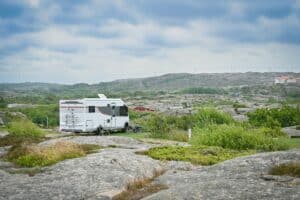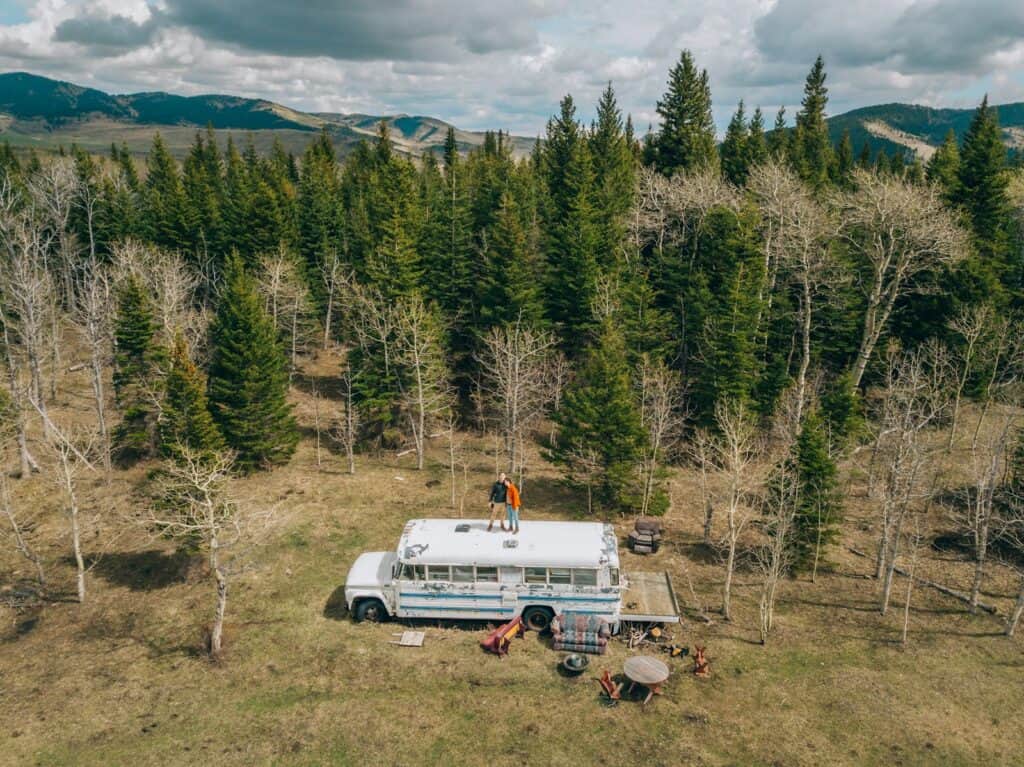
Boondocking is camping in an RV with no water, power or sewer hookups, away from developed campgrounds and usually free of charge, often on Bureau of Land Management (BLM) land or in National Forests. You carry your own water, make your own power and hold your own waste.
The word comes from “boondocks,” which means a remote, thinly settled area. It traces to the Tagalog word bundok, meaning mountain, and US troops brought it into English after occupying the Philippines in the early 1900s.
Boondocking vs dry camping vs dispersed camping: What’s the difference?
All three terms get used loosely, but they differ in ways that matter when you read an agency’s rules.
| Term | What it means | Where it happens | Typical cost |
|---|---|---|---|
| Dry camping | Any RV camping with no water, sewer or electric hookups | Anywhere, including campgrounds without hookups | Free to paid |
| Dispersed camping | The agency term for camping outside a designated campground | Public land, mainly BLM and National Forest | Usually free |
| Boondocking | RVer term for dry camping in remote areas | Remote land outside established campgrounds | Usually free |
Search agency websites for “dispersed camping,” not “boondocking.” That is the term their rules use.
There is also a hosted version. Harvest Hosts members stay overnight at farms, wineries, breweries and similar businesses, with no camping fee, in self-contained RVs. Hosts can charge for extra nights and hookups, and Harvest Hosts suggests spending at least $30 to support each host. Our Harvest Hosts review covers whether the membership is worth it.
Is boondocking legal, and where is it allowed?
Boondocking is legal where the land manager allows it. The two big options are BLM land and National Forests, and each has its own rules.
Bureau of Land Management land
The BLM is the federal agency that manages about 245 million acres of public land, primarily in 12 western states including Alaska. Most BLM land allows dispersed camping unless an area is posted “Closed to Camping.”
The general stay limit is 14 days in any 28-day period, though this varies by state and field office. California’s Bishop Field Office allows only 14 days per year. When you hit the limit, you must move, often at least 25 to 30 miles away.
The BLM’s national best practices, which posted signs and local rules can override, tell you to:
- Use sites that are already disturbed.
- Camp within 150 feet of designated routes.
- Stay at least 200 feet from lakes, rivers and streams.
- Avoid camping within 1 mile of campgrounds, trailheads or picnic areas.
That route distance is about where you camp, not permission to drive there. Vehicles must stay on designated roads and trails unless an area is specifically designated for off-road use.
Not all BLM camping is free. Long-Term Visitor Areas (LTVAs) in California and Arizona are winter camping areas that require a permit. At La Posa in Arizona, a season permit is $180 for September 15 to April 15 and a 14-day permit is $40. La Posa has toilets, water faucets, dump stations (designated spots for emptying RV tanks) and trash service, though amenities differ by LTVA.
National Forests
The US Forest Service manages 193 million acres, roughly the size of Texas. Dispersed camping means camping anywhere on National Forest land outside a designated campground, and it is typically not allowed near campgrounds, picnic areas or trailheads.
Stay limits are usually 14 days, but each forest sets its own. Here are four real examples.
| Forest | Stay limit | What’s different |
|---|---|---|
| Black Hills | 14 days in any 28 days | Camp 1/2 mile from developed sites and 100 feet from creeks |
| Fishlake | 16 days in 30 days | The limit covers anywhere within 5 miles of the same spot |
| Apache-Sitgreaves | 14 days in 30 days | Afterward you must leave the forest for at least 16 days |
| Mount Baker-Snoqualmie | 14 consecutive days | No more than 28 days total in a calendar year |
Distance from water changes too. The forest pages we checked ranged from 100 to 200 feet, so use your forest’s figure, or the larger one if you can’t find it.
Where you can’t boondock
National parks are the big trap. Yellowstone bans overnight parking anywhere other than a designated campground, including pullouts and parking areas. Yosemite does not allow sleeping in your RV outside campgrounds. Some parks, such as Death Valley, allow limited roadside camping, so check each park’s own site before assuming anything.
Posted closures always win, on any land. A pin in an app is not permission.
What do you need to boondock?
In practice the easiest setup is a self-contained RV, meaning one with a toilet, a kitchen setup and onboard waste tanks, plus enough water, power and tank space for the whole stay. The BLM’s camping guidance also accepts a portable toilet, so a simpler rig can work on its land. No amenities are provided at dispersed sites, so whichever supply runs out first ends your trip.
Water
Many boondockers use about 3.5 gallons per person per day. A bare-bones day is closer to 1 to 2 gallons. Campers who don’t conserve can hit 6 or 7 gallons or more.
At the typical rate, two people go through 7 gallons a day, so a 60-gallon fresh tank lasts about eight and a half days. Check your own tank size on the spec sheet, and fill up before you leave pavement.
Water counts toward your load. At about 8.3 pounds a gallon, that full tank adds about 500 pounds, so make sure the loaded rig stays within its weight ratings.
Load treated water at a known potable spigot, and run it through an RV water filter if you want better taste. Creek and lake water is a different matter: You can’t tell whether it’s safe by looking, so boil it for 1 minute (3 minutes above 6,500 feet), or filter and then disinfect it. Boiling and disinfecting won’t make water with harmful chemicals or toxins safe, so use a different source if you suspect them.
Power
A modest daily load is about 1,600 watt-hours (Wh) for an electric fridge, lights, water pump and roof fan. That is about 133 amp-hours (Ah) at 12 volts, and in that example the fridge is three-quarters of it.
Batteries shouldn’t be drained to zero, so usable capacity is what counts. Plan on at least two days of stored power, since solar can’t be relied on through a cloudy stretch.
| Battery type | Usable share of rated capacity | Rated size for two days at that load (12 volts) |
|---|---|---|
| Lead-acid | No more than 50% | About 530 Ah |
| Lithium | About 70% to 80% | About 330 Ah at 80% |
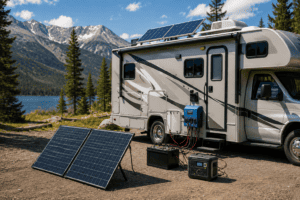
For recharging, a 100-watt solar panel makes roughly 350 Wh a day, depending on weather, season and location. Covering that whole load takes about five panels. Our RV solar kits guide sizes systems by how you camp.
If you only plan a few weekends a year, a big solar build is not worth the money. Trim your load first and add a small kit later if you like boondocking.
A generator can fill the gap.
Propane is the other risk, because you will lean on it for heat and cooking. It is denser than air and usually collects near the floor, so test your propane alarm before each trip.
Waste
Most RVs have two waste tanks: A black tank for toilet waste and a gray tank for sink and shower water. Some small trailers have one combined tank, and some camper vans pair a gray tank with a removable cassette toilet. None of it gets emptied on the ground. Federal rules bar draining sewage from a trailer or vehicle on BLM land outside places provided for it.
National Forest rules require you to remove sewage and waste water from the site or use a place provided for it. That includes gray tanks. At Caribou-Targhee National Forest, emptying one anywhere but a designated dump station is a violation.
The BLM’s federal rule exempts “wash water” without defining it, so don’t read that as a free pass. Local BLM rules go further. The Midland LTVA in California bans dumping gray water on the ground, and the BLM’s California dispersed camping rules bar disposing of it in any manner that would pollute the surrounding area.
Hold it and dump it.
Many Forest Service campgrounds have dump stations, and apps list others nearby, so pick your dump stop before you leave. Pack out all trash too, because there are no bins at dispersed sites. Our beginner RV accessories guide covers the basic hoses and gear.
Leave No Trace basics for RVers
Leave No Trace is a set of seven outdoor ethics principles that public land agencies point visitors to. Here’s how each one applies to an RV.
- Plan ahead and prepare: Know the local rules, your tank levels and your exit route before you go.
- Travel and camp on durable surfaces: Good campsites are found, not made. Park on gravel, rock, sand or a spot already in use, and don’t drive across meadows.
- Dispose of waste properly: Use your onboard toilet. If you ever need a cathole, a small pit for solid human waste, and local rules allow one, dig it 6 to 8 inches deep and 200 feet from water, camp and trails.
- Leave what you find: Don’t trench, dig or level your site, and don’t cut limbs to make room for your rig.
- Minimize campfire impacts: Where fires are permitted, keep them small and use an existing ring or a fire pan, a metal pan that holds the fire.
- Respect wildlife: Watch from a distance and never feed animals.
- Be considerate of other visitors: Camp away from others and let nature’s sounds prevail, which means keeping generator time short.
What are the fire and wildlife rules?
Check fire and food storage rules before you leave, and check fire rules again before you light anything.
Campfires
Campfires are generally allowed at dispersed sites unless a restriction or local rule says otherwise, and it is your job to know. Restrictions change through the year, and humans cause nine out of 10 fires. Skip the fire when danger is high, even if no order is posted.
The BLM’s fire restrictions page links to current restrictions by state or region. For National Forests, ask the forest or the ranger district, its local office.
Some places add permits. On National Forest and BLM land in California, a free campfire permit is required year-round outside developed recreation areas. It covers campfires, plus charcoal barbecues, gas stoves and lanterns used outside your RV.
On BLM land there, outside developed campgrounds, you also need a five-foot-diameter area cleared to bare soil with no flammable material overhead, plus a working round-point shovel at least 35 inches long. Some BLM areas there, including parts of Southern California, ban open fires even with a permit, so check with the local BLM field office before you light one.
When a fire is allowed, burn only wood and paper, and collect only dead and down wood, and only where gathering is allowed. Before bed or before leaving, drown it and stir it until it’s cold to the touch.
Wildlife and food storage
Black bears quickly learn to link people with food, and they can open car doors, camper hatches and coolers. In bear country, store food, drinks, garbage, coolers, pet food, cookware and scented toiletries in a locked hard-sided vehicle or RV, or a bear-resistant locker, not outside under the awning. A tent or soft-sided camper doesn’t count.
Local rules come first. Yosemite, for one, bans food in cars and trucks after dark, though it allows food out of sight in hard-sided RVs with doors, windows and vents closed.
In some forests this is law, not advice. Mount Baker-Snoqualmie has a forest-wide order requiring food to be stored in a bear-resistant manner. Keep pets under control.
How do you find boondocking sites?
Start with the land manager’s own maps, then use apps to fill in the details.
- Pick the land. Use the Forest Service Interactive Visitor Map, or ask the local BLM office what’s near your route.
- Check the roads. On National Forests, get the free Motor Vehicle Use Map (MVUM), which shows designated roads. Routes not on it are not open to motor vehicles, and knowing that is your responsibility. Driving off a road to reach a dispersed campsite is allowed only where the forest’s map designates it, so check before you turn off.
- Read recent reports. Campendium lets you pick the Public Land category, set the nightly rate to $0 and filter by BLM or National Forest. A free listing does not mean camping is currently permitted, so use it to shortlist, not to confirm.
- Call the local office. Confirm the rules, and ask whether your rig fits the road.
- Save a backup. Have a second site picked, and tell someone where you’re going and when you’ll be back. If you work on the road, see our Starlink for RV guide before you count on a signal.
Who should you check with before you go?
Check with the office that manages the exact land you’ll camp on, not a forum or a regional summary.
| Where you’re going | Who to ask | What to ask |
|---|---|---|
| BLM land | The local BLM field office | Stay limit, moving distance, closures |
| National Forest | The ranger district or Forest Supervisor’s Office | Stay limit, MVUM, food storage orders |
| LTVA | Yuma, El Centro or Palm Springs-South Coast Field Office | Permits and open dates |
| National park | That park’s website or visitor office | Whether any overnight parking is allowed |
The BLM links to its local offices from its national office contact page, and each forest’s website gives its contact details. As examples, the Black Hills Supervisor’s Office is at (605) 673-9200, Fishlake’s is at (435) 896-9233 and Coronado’s is at (520) 388-8300.
Is boondocking worth it for beginners?
Yes, if you start small and you like the idea of quiet over convenience. The savings are real, but you pay for them in planning and in watching your tanks and batteries.
For a first try, pick a mild-weather weekend, one or two nights, and a site near a town with water and a dump station. If you don’t own an RV yet, renting before you buy is a lower-risk way to find out if you enjoy it, but ask the rental owner first whether off-grid stays are allowed.
Stay limits, fees and fire rules change, so treat the figures here as a starting point and let the local office have the last word.
Sources
Rules come from federal agency pages and federal regulations, with water and power figures from published guides, all opened November 2026.
Bureau of Land Management: Camping on Public Lands · La Posa Long Term Visitor Area · Midland Long Term Visitor Area · Fire Restrictions · California Fire Information · Recreation Activities: California · Recreation Activities: Nevada · BLM Utah: Dispersed Camping · BLM Takes Historic Action to Settle Alaska’s Land Pattern · National Office Contacts
US Forest Service: Pacific Southwest Region: Dispersed Camping · Intermountain Region: Dispersed Camping · Caribou-Targhee Dispersed Camping · Eldorado Campfire Permits · Sequoia Firewood Cutting and Gathering · Black Hills National Forest · Black Hills Alerts · Fishlake 16-Day Camping Limit · Apache-Sitgreaves Dispersed Camping Guidelines · Mount Baker-Snoqualmie Dispersed Camping · Helena-Lewis and Clark Dispersed Camping · Coronado Dispersed Camping · White River Camping Tips · Fire · Maps · Meet the Forest Service
National Park Service: Leave No Trace Seven Principles · Yellowstone Camping · Visiting Yosemite With an RV · Bears at Yosemite · Death Valley Backcountry Camping · Lassen Volcanic Camping · Safety in Bear Country · Chosa Campground (BLM)
Cornell Legal Information Institute: 43 CFR 8365.1-1 · 43 CFR 8360.0-5 · 36 CFR 261.11 · 36 CFR 212.51 · 36 CFR 261.13
Centers for Disease Control and Prevention: Carbon Monoxide Poisoning Basics · Water Treatment While Hiking, Camping, and Traveling · About Water Treatment Options When Hiking, Camping, or Traveling
US Consumer Product Safety Commission: Generators and Engine-Driven Tools · CPSC Warns of Generator, Carbon Monoxide and Fire Hazards
Leave No Trace: Principle 3: Dispose of Waste Properly · Principle 5: Minimize Campfire Impacts
CAL FIRE: Permits
Merriam-Webster: Boondocks
etrailer: How Long Can You Boondock in an RV?
Engineer Fix: How Much Water Does an RV Use Per Day?
Victron Energy: RV Battery Bank Size
Battle Born Batteries: How Much Solar Do I Need?
Forest River: RV Safe LP Alarm Owner’s Manual
Campendium: What Is Boondocking
Harvest Hosts: Harvest Hosts · What Is Boondocking? · How Much Should I Spend at a Host Location? · Host Code of Conduct
Airstream: 2026 Basecamp Owner’s Manual · Understanding and Emptying Your RV Holding Tanks · How Much Weight Can My Touring Coach Carry?
Winnebago: Solis Pocket 36B
Palomino: Real-Lite RL 186 and RL 189 Brochure