The best RV tires for most owners are the Goodyear Endurance for travel trailers and fifth wheels and the Michelin Agilis CrossClimate for motorhomes on 16-inch light truck tires, as long as the size and load range match your vehicle’s placard. Motorhomes on 22.5-inch tires are better served by a Michelin XRV or XZE from a commercial tire dealer.
Which RV tire should you buy?
Start with the size on your placard, because that decides which type of tire you can use. These are our picks for each type.
| Tire | Type | Best for | Where to buy |
|---|---|---|---|
| Goodyear Endurance | ST (special trailer) | Most travel trailers and fifth wheels | Amazon or tire dealer |
| Carlisle Radial Trail HD | ST (special trailer) | Trailers that came with Carlisle tires | Amazon or tire dealer |
| Michelin Agilis CrossClimate | LT (light truck) or C-metric (commercial) | 16-inch motorhomes that see wet or mixed weather | Amazon or tire dealer |
| Michelin XPS Rib | LT (light truck) | 16-inch motorhomes that mostly run highways | Tire dealer |
| Michelin XRV or XZE | Commercial, 22.5-inch | Motorhomes on 22.5-inch wheels | Commercial tire dealer |

Goodyear Endurance
Polyester construction with steel belts, an inner liner that limits air loss, and a sidewall scuff guard. Sizes include ST205/75R14 at load range D and ST255/85R16 at load range E. Plan on replacing it within six years of going into service, the shortest age limit among our picks. This link is for ST225/75R15, so confirm your size before you order.

Carlisle Radial Trail HD
A 13-inch to 16-inch ST tire in load ranges C through F, made for towable RVs, boat trailers, and cargo trailers. Carlisle is original equipment on many trailers, so this is the simple swap if yours came with it. This link is for ST225/75R15 load range D, so confirm your size before you order.

Michelin Agilis CrossClimate
An all-weather light truck tire built for high-stress commercial use, with an emphasis on durability, mileage, and wet braking. Michelin includes it in its RV lineup. This link is for 225/75R16C load range E, so confirm your size before you order.
Michelin launched the Agilis CrossClimate 2 in 2025, so check the DOT date on older stock. If a dealer offers the new version, confirm its load rating and RV suitability for your size first.
For highway miles, ask a tire dealer about the Michelin XPS Rib. It is an all-steel highway rib tire that fits any wheel position, designed for mileage in van, bus, and light truck fleets. Michelin pitches it on mileage and fuel economy rather than wet braking, so choose the Agilis CrossClimate if wet roads are a regular part of your trips.
Michelin’s pages differ on whether it is a summer or all-season tire, so ask the dealer if you expect cold or snow.
For 22.5-inch motorhomes, the Michelin XRV is designed specifically for recreational vehicles and comes in 235/80R22.5, 255/80R22.5, and 305/70R22.5. The XZE is a radial that fits any wheel position, in sizes including 275/80R22.5. We do not link these on Amazon because they are dealer purchases.
Where do you find the right tire size?
Your placard is the tire and loading label the manufacturer put on the vehicle, and it lists the original tire size and cold pressure. Federal rules require the tires on a motor home or RV trailer rated over 10,000 pounds to match the labeled size at first retail sale, and lighter vehicles must show the original tire size on the placard.
On a motorhome, check the driver’s door edge or the pillar next to the driver’s seat. On a trailer, check near the VIN (vehicle identification number) label on the front left side. The owner’s manual has the same details.
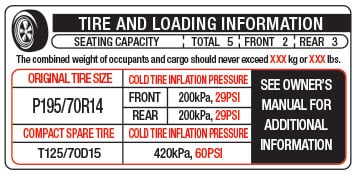
Trust the label over the tires now on the RV, since a past owner may have changed them. Michelin’s advice is to keep the placard size and consult an RV or tire dealer before changing it.
ST vs LT vs commercial tires: What is the difference?
The letters before the size tell you what the tire was built to do. ST means special trailer, LT means light truck, and commercial covers C-metric sizes and the larger 19.5-inch and 22.5-inch tires.
| Type | Sidewall example | When it applies |
|---|---|---|
| ST (special trailer) | ST225/75R15 | Trailers only, never a motorhome or tow vehicle |
| LT (light truck) | LT225/75R16 | Motorhomes and vans with an LT size on the placard; possible on trailers with conditions |
| C-metric (commercial light truck) | 225/75R16C | Vehicles with a C-metric size on the placard |
| Commercial medium duty | 225/70R19.5, 255/70R22.5 | Larger motorhomes with 19.5-inch or 22.5-inch wheels |
ST tires have stiffer sidewalls meant to control trailer sway. They also carry more at the same size and pressure. An ST235/85R16 load range E is rated for 3,640 pounds, while an LT235/85R16 load range E carries 3,042 pounds on a single wheel, not duals, both at 80 psi (pounds per square inch).
Sizes that look identical can differ just as much. A 225/75R16C Agilis CrossClimate is rated for 3,195 pounds at 83 psi, while the LT225/75R16 version carries 2,680 pounds at 90 psi, both on a single wheel.
Swapping one for the other because the numbers match can leave you short on capacity.
Michelin recalled some C-metric sizes in 2023, including 225/75R16C, because they did not meet snow traction requirements. The recall covers DOT codes 0117 through 1423, meaning week 1 of 2017 through week 14 of 2023, and its remedy was free replacement at a dealer. LT sizes were not included, and Michelin Consumer Care can confirm whether a tire is affected and whether replacement is still available.
Switching a trailer from ST to LT is not a simple upgrade, and Carlisle’s position is that LT tires are not designed for trailer use. If you do it anyway, ask your trailer maker or a tire dealer first.
One retired tire engineer’s guideline is that the LT tire should support at least 115 percent of your measured heaviest load, and 125 percent is better. It should also have a nylon or aramid cap belt, a reinforcing layer over the steel belts, and your wheels must be rated for its load and pressure.
What does load range mean?
Load range is the letter that identifies a tire’s load and inflation limits. Two tires can have the same dimensions and carry very different weights, which is why the letter matters as much as the size. The scale runs from A, the lowest, to N, the highest.
| Load range | Carlisle maximum pressure | Carlisle example | Rated load |
|---|---|---|---|
| C (6-ply rating) | 50 psi | ST205/75R15 | 1,820 lb |
| D (8-ply rating) | 65 psi | ST225/75R15 | 2,540 lb |
| E (10-ply rating) | 80 psi | ST225/75R15 | 2,830 lb |
| F | 95 psi | ST235/85R16 | 3,960 lb |
A higher load range does not raise what your RV can carry. You must stay under the sidewall rating or the vehicle’s rating, whichever is lower, so extra capacity on the tire does nothing for your axles or wheels. Moving up a range is usually worth it only when your weights show you need the margin.
How fast can you drive on RV tires?
Many ST tires are rated at 65 mph, and Carlisle’s default for a trailer tire with no speed symbol is 62 mph. Always read your actual sidewall, because ratings vary by model and size.
| Tire | Rated speed |
|---|---|
| Goodyear Endurance (symbol N) | 87 mph |
| Carlisle Radial Trail HD, ST225/75R15 and ST205/75R15 | 81 mph |
| Carlisle Radial Trail HD, ST235/85R16 | 75 mph |
| Michelin Agilis CrossClimate LT | 106 mph |
| Michelin XPS Rib, XRV, and XZE | 75 mph |
A high rating is not permission to tow faster. ST load ratings have traditionally been tied to that 65 mph figure, so our advice is to hold your trailer to that speed even on a tire rated higher, and to follow any lower limit on your tire or the road.
A speed rating also says nothing about what your vehicle can safely do, and going past a tire’s maximum builds excessive heat.
How do you read an RV tire sidewall?
The sidewall gives the tire’s type, size, load, speed, and age in one line of code. Here is what each part of LT225/75R16 115/112R E means.
| Marking | Meaning |
|---|---|
| LT | Light truck tire; ST would mean special trailer |
| 225 | Section width in millimeters, sidewall to sidewall |
| 75 | Aspect ratio, the section height as a percentage of the width |
| R | Radial construction |
| 16 | Wheel rim diameter in inches |
| 115/112 | Load index, showing how much weight the tire supports when properly inflated, on a single wheel (115) and on dual wheels (112) |
| R | Speed symbol |
| E | Load range |
To find the tire’s age, look for the DOT Tire Identification Number. DOT is the US Department of Transportation, and the last four digits of the number give the week and year the tire was made, so 2324 means the 23rd week of 2024.
That number may be on one side only, so check the inboard side if you do not see it.
The sidewall also lists a maximum pressure, which is a limit for the tire and not the pressure your RV needs.
How old is too old for RV tires?
Some vehicle and tire makers recommend replacing tires at six to 10 years old regardless of tread wear. You cannot spot aging by looking at a tire, and good tread proves nothing. The limit that applies to you is the one for the tire on your RV.
| Tire | Age limit | When the clock starts |
|---|---|---|
| Goodyear Endurance | Six years | The day it went into service, or the DOT date if you do not know |
| Michelin Agilis CrossClimate, XPS Rib, XRV, and XZE | 10 years | The DOT date |
| Carlisle Radial Trail HD | None in its FAQ; we suggest six years at most | The DOT date |
Goodyear’s policy for its RV tires is replacement six years after they go into service, spares included. That limit holds even if your vehicle maker allows longer. The policy covers all its RV tires without naming trailer tires or the Endurance, so we apply it to the Endurance.
Michelin’s policy is a specialist inspection at least once a year after five years in service, and replacement 10 years from the manufacture date, spares included.
Michelin’s 10 years is not permission to run a Goodyear tire past six.
If your vehicle maker sets a shorter limit than the tire maker, follow it.
Carlisle gives no fixed age in its FAQ but warns that storage under load can break down a tire’s internal structure unseen.
Our advice is to start annual professional inspections at five years and replace each tire by its maker’s limit. Where we find no current limit from a maker, plan on six years at most. If you park for the season, keep tires covered from sunlight along with the rest of your winterizing routine.
How do you set RV tire pressure by weight?
The correct RV tire pressure starts with what the vehicle maker lists on the placard, not the maximum on the sidewall. Motorhome owners can then refine it, because the right pressure depends on your actual loaded weight.
- Load up as you travel. Include passengers, cargo, fuel, and water. If you tow, also weigh the whole loaded setup to check your gross combined weight rating (GCWR), the limit for both together. Tire pressure comes from the weight on each RV wheel.
- Weigh each wheel position. Use a professional weighing service, because an axle can be within its rating while one side is overloaded.
- Find the heaviest end of each axle. That weight sets the pressure for the whole axle.
- Check the tire maker’s load table. Use the current table for your exact tire, find the single or dual wheel rating, and read the load at each pressure. Michelin’s tables list the total load at each axle end.
- Set pressure cold. Check after the RV has been parked at least three hours, and set all tires on an axle to the same pressure. Michelin’s maximum allowable difference across an axle is 5 psi.
Here is how the math works with Goodyear’s table for an ST235/85R16 on a trailer. If your heaviest wheel carries 3,000 pounds, 60 psi supports 3,060 pounds and just clears it, but that only shows the minimum and is never a reason to go below the placard. Adding a 15 percent reserve means 3,450 pounds, which takes 75 psi at 3,480 pounds.
On a trailer, never go below the placard. Carlisle’s own instruction for its trailer tires is to run the sidewall maximum, and it calls underinflation the top cause of trailer tire failure. If you run above the placard, never exceed the limit stamped on your wheels.
Check pressure at least weekly and before long trips, and every morning on the road. A hot tire can read 10 to 15 psi higher than it did cold, and that is normal, so never bleed air from a hot tire.
What is the real risk of an RV tire blowout?
Underinflation and overloading cause heat buildup and internal damage, and the failure can come hours, days, or months later.
If a tire lets go, hold the wheel firmly with both hands and do not brake hard. In a motorhome, keep your foot on the accelerator briefly, then ease off gradually. When towing, let the rig slow on its own. Steer toward the shoulder as speed drops, turn on your hazard lights, and brake gently only once you are slow and tracking straight. Pull over a safe distance from the road.
A tire that has run below 80 percent of its recommended pressure counts as flat. The casing, the tire’s inner structure, can be permanently damaged, and some signs show only on the inside once the tire is off the wheel. On dual wheels, the partner tire was overloaded too, so both need inspection.
Do not add air to that tire. It may be damaged on the inside and can explode during inflation, so have a qualified tire technician remove and inspect it.
Call a tire professional or a certified RV technician if you find a bulge, deep cracks, or a tire that ran low, and do not drive on it to save a tow. Goodyear’s rule for a crack deeper than 2/32 of an inch is replacement, and Michelin’s is a dealer inspection that may end in replacement.
Replace any tire with tread worn to 2/32 of an inch, or 4/32 on the front axle of a motorhome rated over 10,000 pounds.
Should you buy RV tires on Amazon or from a tire dealer?
Amazon can work for ST and 16-inch LT tires when you know your exact size and load range, and you are willing to pay a shop to mount and balance them. Check the DOT date when they arrive. Michelin’s age limit counts from that date and not from purchase, and Goodyear’s does too if you cannot tell when the tire went into service.
Buy from a tire dealer when your RV uses 19.5-inch or 22.5-inch tires, when you are changing size or type, or when you want the weighing and pressure work done in one visit. Michelin also points owners to its service dealers for pressure adjustments.
Tires on the same axle must be compatible. If you replace only two on a two-axle trailer, keep the new pair together on one axle.
Tires are only one part of road readiness. Our beginner RV accessories guide covers the other basics, and you can compare motorhome types in Class A vs B vs C or browse more RV gear picks.
Sources
Built from manufacturer tire guides and product pages, federal safety rules, and independent tire engineering articles, opened November 2026.
NHTSA: Tires · Interpretation letter on load range markings · Recall 23T-002 acknowledgment letter
Code of Federal Regulations (Cornell LII): 49 CFR 571.120, tire selection and rims · 49 CFR 571.110, tire selection and rims for lighter vehicles
Michelin: RV tires · RV load and inflation tables · RV Tire Guide, May 2025 · Service life bulletin for RV tires · RV tires brochure, 2017 · XRV · XPS Rib · XPS Rib, Michelin Canada · Changing tire size or specifications · Agilis CrossClimate · Agilis CrossClimate 2 · April 2023 recall · Tire blowout
Goodyear: Endurance trailer tire · Bulletin on RV tire service life, 2022 · RV load and inflation tables, 2017 · Tire care guide
Carlisle (Carlstar): Radial Trail HD specs · Radial Trail HD applications · Frequently asked questions
Good Sam: Goodyear Endurance ST205/75R15 · Goodyear Endurance ST255/85R16 · Tire speed rating · Tips on what to do if an RV tire blows out
US Tire Manufacturers Association: Tire Care and Safety Guide · Care and Service of Commercial Truck and Bus Tires · Replacing tires
Continental: How to read your tire sidewall
Modern Tire Dealer: Michelin’s Agilis CrossClimate 2 serves LT, van fleets
Carry-On Trailer: How to handle a towing emergency
RVtravel: Must I use ST tires on my travel trailer, or can I use LT-type?
Felling Trailers: Tire safety information