Harvest Hosts is an annual membership that lets self-contained RVs (rigs with their own toilet and waste tanks) park overnight at farms, wineries, breweries, museums and other small businesses with no camping fee, in exchange for a suggested purchase of about $30 from each host. As of November 2026 the Classic plan lists at $99 a year, and it pays for itself in two or three nights if you would otherwise stay at private RV parks, but not if you mostly use cheap public campgrounds.
This Harvest Hosts review sticks to what the company itself publishes, including its plans, its booking rules, its etiquette expectations and its own numbers. Then it runs the break-even math against a published campground price survey, so you can decide with real figures instead of hype.
What is Harvest Hosts?
Harvest Hosts is a network of small businesses that let members park an RV overnight on their property. The official site describes it as “unlimited overnight stays with no camping fees” at host locations that include farms, wineries, breweries, distilleries and museums across North America.
The size of the network depends on which page you read and which plan you buy. The homepage advertises 9,600+ sites, while the FAQ section on the same page cites “9,500+ Hosts across 49 US states and 10 Canadian provinces.”
The help center’s plan comparison gives a narrower figure for the base plan: Harvest Hosts Classic features “over 5,700 host locations,” and the All Access bundle “provides access to over 9,300 hosts.” The gap suggests the bigger headline numbers also count hosts from the sister programs, so check which plan actually unlocks the spots you want.
This is not a campground. You get a parking spot, usually for one night, and the point is the visit itself, whether that is a tasting room, a farm stand or a brewery dinner.
If you want hookups (power, water and sewer connections at the site), a picnic table and a fire ring every night, Harvest Hosts is the wrong tool.
How much does Harvest Hosts cost in 2026?
Harvest Hosts sells three main plans. The prices below are the regular annual rates shown on harvesthosts.com as of November 2026, alongside the discounted first-year prices the site was displaying at the same time.
| Plan | Regular price per year | First-year price shown (November 2026) | What it adds |
|---|---|---|---|
| Harvest Hosts Classic | $99.00 | $84.15 | Small business hosts such as farms, wineries and breweries |
| Harvest Hosts + Boondockers Welcome | $169.00 | $143.65 | Adds private property hosts from Boondockers Welcome |
| Harvest Hosts All Access | $179.00 | $152.15 | Adds Golf Hosts and an Escapees RV Club membership ($49.95 value) |
The FAQ frames the discount as a first-year offer, “as low as $84.15 for your first year,” and the help center says promotions such as first-year discounts apply only to new members. Budget for the regular price when you renew.
Membership runs for 365 days from the day you join and renews on that same date each year.
A few extras come with every plan. The site lists a 90-day guarantee (“Refund within 3 months if you aren’t a happy camper”), up-to-date info on thousands of dump stations (where you empty your RV’s waste tanks) and what it calls $5,000 in RVing discounts.
Taxes are added based on your billing address, and the help center notes that Canadian members pay regional taxes such as GST or HST and that international members may see currency conversion fees.
How does booking a Harvest Hosts stay work?
Most bookings run through the Harvest Hosts website and app, although a few hosts take requests by phone or email instead. You find a host on the Discover map, check its calendar and send a stay request, which the host approves or declines. The basic flow looks like this.
- Find a host that fits your rig. Use the Rig Length filter on the Discover map so you only see locations that can take your RV.
- Check the calendar. According to the help center, hosts using Request-A-Stay typically open availability 90 to 180 days in advance, and some accept same-day requests when their profile allows it.
- Send the request and wait. The help center suggests allowing 24 to 48 hours for a host to approve a request, and following up through the message center after two or three days if you hear nothing.
- Get the address and arrival details. The host’s address is shared with you once your request is approved.
- Arrive during business hours. The help center is direct about this: “You must arrive during business hours, unless the Host says otherwise.”
The standard stay is one night. Some hosts offer extra nights, which you can find with the “Stay Extra Nights” filter, and the company’s guide notes that extra nights can carry their own fees. If you are planning a long weekend in one place, Harvest Hosts is usually a stopover, not a base camp.
What happens if you cancel or do not show up?
Cancellations matter more here than at a campground, because a real business owner is holding space for you. The help center asks members to cancel before the 24-hour window.
A no-show earns an automatic 1-star member rating that other hosts can see, a second no-show brings a follow-up from member support, and “the third No-Show will result in a membership suspension for up to one year,” with no refund.
What are the RV requirements for Harvest Hosts?
The one firm requirement is that your rig is fully self-contained. The FAQ defines that as having “an interior toilet and onboard waste tanks,” and the company’s guide adds an interior cooking setup. The help center goes further: it also requires an installed sink that drains to a greywater tank and built-in sleeping surfaces, and a porta-potty counts only if it stays inside.
Motorhomes, fifth wheels, travel trailers, truck campers and many Class B vans qualify, while tents, vehicles without a bathroom and rooftop tents do not.
There is no single size limit. Each host sets its own, and the help center publishes the share of hosts that can fit different lengths. For the Harvest Hosts network, it lists about 72% of hosts for rigs up to 40 feet, 65% for rigs up to 45 feet and 51% for rigs over 45 feet.
Those lengths include any trailer or towed vehicle, so measure your whole setup. If you are willing to unhitch, the help center lets you leave the towed unit out.
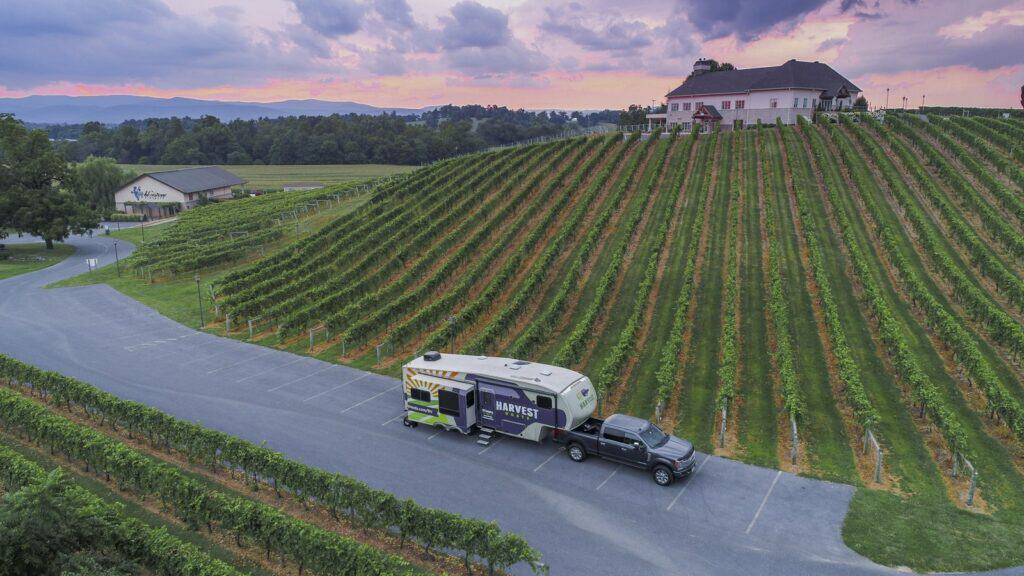
Parking is often basic. The help center says the surface “might be concrete, asphalt, gravel, grass or dirt,” and you may be parked in a field, orchard or vineyard.
A set of leveling blocks earns its keep here, and the help center asks members to use jack pads on asphalt so stabilizer jacks do not damage the host’s lot.
What is the etiquette at a Harvest Hosts location?
The etiquette boils down to remembering that you are a guest at someone’s place of business. Harvest Hosts asks members to “purchase something from your Host as a thank you,” and its help center suggests “spending a minimum of $30 in support of your Host.”
That spend can be wine, produce, a meal, a museum visit or a hookup fee, and if a host has nothing to sell, the help center says a donation is appropriate.
A few rules catch first-timers. Unless a host’s profile says otherwise, Harvest Hosts does not allow cooking outside the RV, which includes outdoor kitchens, grills and campfires. Some hosts permit bonfires at their discretion, subject to local laws.
Generator rules vary by host, and the help center notes that most hosts are fine with generators used sparingly. If you rely on power overnight, a quiet solar setup makes these stays easier.
- Read the profile first: Each host lists its own arrival hours, parking notes, rig limits and pet rules.
- Call if the host asks: The company’s etiquette guide says that if a host takes bookings by phone, you should call ahead to let them know you plan to visit.
- Keep noise low: Overnight quiet hours are the norm, according to the company’s guide.
- Check the pet policy: Harvest Hosts says over 90% of hosts are pet-friendly, but working animals and livestock mean pets may not roam freely.
How does Harvest Hosts relate to Boondockers Welcome?
Boondockers Welcome is Harvest Hosts’ sister program, and its own site calls it “part of the Harvest Hosts family.” Instead of businesses, its hosts are private property owners who let RVers park on their land, and members of both programs can search both networks in one app.
The two programs work differently. The help center lists Boondockers Welcome on its own at $79 a year with “over 3,400 host locations,” and stays run from 1 to 5 nights depending on the host, with a cap of 5 nights in a 90-day window with the same host. There is no purchase expectation. The help center says the only costs at these hosts are for optional hookups.
If you want longer, quieter stays more than tasting rooms, the combined plan is the one to look at.
Is Harvest Hosts worth it? The break-even math
The Classic plan is worth it if you will use it for at least two or three nights a year instead of paying for a private RV park. To check that, you need a realistic campground price to compare against.
The Outdoor Hospitality Pricing Index from Insider Perks, which tracks pricing from more than 23,000 properties, put the average U.S. RV site at $73.20 per night in June 2026 and the average federal public campground at $34.12 per night.
The fair way to run the math is to treat the suggested $30 host purchase as part of the cost, even though you do get something for it. That makes each Harvest Hosts night worth about $43.20 in savings against an average RV site ($73.20 minus $30).
Here is how quickly each plan pays for itself at that rate.
| Plan (regular price) | Nights to break even vs. average RV site ($73.20) | Nights to break even vs. average federal public campground ($34.12) |
|---|---|---|
| Classic ($99) | 3 nights | About 25 nights |
| Harvest Hosts + Boondockers Welcome ($169) | 4 nights | Over 40 nights |
| All Access ($179) | 5 nights | Over 40 nights |
The second column is the honest catch. If your alternative is a national forest or other federal campground at public-campground prices, the $30 spend wipes out almost all of the savings, and the membership rarely pays off on cost alone.
In that case you are paying for the experience and the convenience of a one-night stopover, which can still be worth it, but it is not a money saver. For the bigger picture on trip costs, see our RV rental cost guide.
Pros
- No nightly camping fee at thousands of small business locations
- Pays for itself in a few nights against average private RV site prices
- Easy one-night stopovers on long drives
- 90-day refund guarantee for new members with two or fewer completed stays
- Stays at wineries, farms and breweries are more memorable than a highway rest stop
Cons
- Suggested $30 spend per stay cuts the real savings
- Usually one night only, and extra nights can cost extra
- Requires a fully self-contained rig
- Must arrive during business hours unless the host says otherwise
- No outdoor cooking unless the host allows it, and generator use is limited
- Fewer options for rigs over 45 feet
Who is Harvest Hosts best for, and who should skip it?
Harvest Hosts suits travelers who cover a lot of ground and want an interesting place to sleep between destinations. It works well if you enjoy wine, craft beer, farm food or small museums, since the suggested purchase then feels like part of the trip rather than a fee.
It also suits self-contained rigs under 40 feet, which can use the largest share of hosts.
It is a weaker fit if you like to stay put for several nights, need full hookups every night, rely on running a generator for hours, or mostly camp at low-cost public campgrounds. Tent campers and vehicles without an onboard toilet cannot use it at all.
And if you only take one or two RV trips a year, run your own numbers before paying for a full year.
If you are renting rather than owning, confirm the rig has an interior toilet and holding tanks before you count on Harvest Hosts stays.
Our RV rental guide covers how to pick the right unit, and our list of beginner RV accessories covers the basics worth bringing to any dry camping spot, meaning one without hookups.
New to RV travel?
Before you buy any camping membership, get the basics of rigs, routes and budgets sorted so you know how many nights you will really use it.
Start hereWant to compare plans yourself? Current prices and terms are on the official site at harvesthosts.com.