Most RV owners who want to run a microwave from their batteries need a 2,000-watt pure sine wave RV inverter, while a rig that only runs a TV, laptop and chargers can get by with about 1,000 watts. For your exact size, add up everything you will run at once, add 20%, then confirm your battery bank and cables can carry the current.
If you always camp on full hookups, you may not need an inverter at all, because your outlets already work on shore power. It earns its place when you camp without hookups and want outlets without running a generator.
What does an RV inverter do?
An inverter turns the direct current (DC) stored in your 12-volt house batteries into the 120-volt alternating current (AC) your outlets and household appliances use. It is the reverse of the converter already in most RVs, and the names are easy to mix up.
Inverter vs converter vs inverter charger
Each device moves power in a different direction, and only one of them does both jobs.
| Device | Power flow | What it does for you |
|---|---|---|
| Converter | AC to DC | Charges the house batteries while you are plugged in |
| Inverter | DC to AC | Runs AC appliances from the batteries |
| Inverter charger | Both | Combines the two jobs in one unit, usually with a transfer switch |
A plain inverter does not charge your batteries, so you keep your converter. An inverter charger replaces it, and the old converter gets removed or disabled so two chargers are not working on one battery bank.
Pure sine or modified sine: Which do you need?
Buy pure sine wave. It produces a smooth voltage curve, while a modified sine wave inverter produces a choppy, stair-step signal.
Modified sine can run simple loads such as basic lights and pumps, though those may hum or run hotter. The trouble shows up with everything else. Microwave clocks can lose time, motor speed controls can misbehave, laser printers may not work properly, and some cordless tool chargers can be damaged.
Refrigerators, microwaves, fans and power tools all belong on pure sine power.
For medical equipment such as a continuous positive airway pressure (CPAP) machine, check the device instructions or ask its maker what power it can use, since requirements vary by model.
A modified sine unit only makes sense as a small portable for simple loads, and it is not worth building into an RV.
What size inverter do you need?
Size for the worst moment of your day, not your daily total. Sizing takes four steps:
- List what runs together Include only the appliances you will really use at the same moment.
- Find the input watts Check each appliance label or spec sheet, because cooking power and power draw are different numbers.
- Add 20% This cushion keeps the inverter from running at its limit.
- Check surge Motors need a brief burst to start, so confirm the surge rating covers anything with a compressor.
Real appliance wattages
These are published figures to use until you can read your own labels. Your appliance may differ.
| Appliance | Watts |
|---|---|
| RV microwave, Furrion Greystone 1.3 cu ft (input) | 1,500 |
| Coffee maker | 900 to 1,200 |
| Toaster | 800 to 1,400 |
| Hair dryer | 1,200 to 1,875 |
| Frost-free refrigerator, 16 cu ft | 725 |
| Flat-screen TV | 120 |
| Laptop | 50 |
| Phone charger | 5 to 20 |
The microwave is the line that catches people out. That Furrion cooks at 1,000 watts but consumes half again as much, and the inverter has to supply the higher number.
Worked example: Three RV power setups
Here is the math for three setups, using the top figure where the table gives a range. Multiply the total by 1.2, then round to a real inverter size.
| Setup | Running together | Total watts | Plus 20% | Inverter size |
|---|---|---|---|---|
| Light use | 120 TV + 50 laptop + 20 phone | 190 | 228 | Small unit, about 1,000 W leaves room to grow |
| Microwave | 1,500 microwave + 120 TV + 50 laptop | 1,670 | 2,004 | 2,000 W |
| Microwave and home fridge | Microwave setup + 725 refrigerator | 2,395 | 2,874 | 3,000 W |
The microwave setup lands 4 watts over 2,000, which does not matter: 20% is a cushion, not a limit, and the real load is 1,670 watts. Larger inverters use more power just sitting idle, so do not oversize without a reason.
A 2,000-watt inverter is tight for a hair dryer on high. Run it alone, or use a lower setting.
What about the air conditioner?
Assume a rooftop air conditioner stays on shore or generator power. One 13,500 British thermal unit (BTU) Dometic Penguin II lists 15.3 amps at full-load cooling, which is about 1,760 volt-amps at 115 volts before you count start-up current.
Air conditioners have the highest start-up current of the common appliances in an RV, and the Xantrex Freedom X 2000 will not run an air conditioner that draws more than its rated watts.
What battery bank and cables do you need?
A big inverter on a small battery bank will shut down or trip. The bank has to pass two separate checks: Current and daily capacity.
Check the current first
Divide AC watts by battery voltage, then by inverter efficiency. Renogy lists above 87% at full load for its 2000W model, so the math for the microwave setup is:
1,670 W ÷ 12 V ÷ 0.87 = 160 amps of DC current
A Battle Born 100-amp-hour (Ah) lithium battery is rated for 100 amps continuous and 200 amps for 30 seconds. A microwave running for several minutes outlasts that surge window, so this setup needs two batteries in parallel for 200 amps continuous. That fits Battle Born’s own minimum of 100Ah for every 1,000 watts of inverter.
Then check daily capacity
Next, total the energy you use in a day. Watt-hours are watts multiplied by hours, as this sample day shows.
| Load | Watts | Time | Watt-hours |
|---|---|---|---|
| Microwave | 1,500 | 10 minutes | 250 |
| Coffee maker | 1,200 | 5 minutes | 100 |
| TV | 120 | 3 hours | 360 |
| Laptop | 50 | 3 hours | 150 |
| Daily total | 860 |
For a rough figure at the battery, reuse that 87% full-load efficiency: 860 Wh ÷ 0.87 = 989 Wh, and 989 Wh ÷ 12 V = 82 Ah. Lead-acid banks are usually planned around a 50% depth of discharge, which doubles the need to about 165 Ah. The Battle Born lithium battery above is rated for 100% of its capacity.
Check your inverter’s minimum as well. Xantrex calls for 100Ah or more on the Freedom X. You also have to put those amp-hours back, which is where an RV solar kit or a generator comes in.
An inverter left on with nothing running still drains the battery, so switch it off when you are not using it. Go Power lists up to 2.0 amps of no-load draw on its ASW-1800-12-TS, which adds up to 48 Ah over 24 hours unless its power-saving mode is on.
Cable and fuse sizes
Inverter cables are thick and short because current this high wastes power and creates heat in thin or long wire. Aim to keep voltage drop below 2.5%, or 0.3 volts on a 12-volt system. Every inverter needs its own fuse in the positive cable near the battery.
Follow your own manual rather than a general chart, since makers differ. Wire size below is in American Wire Gauge (AWG), where a smaller number means thicker wire and 2/0 is thicker than 1/0. Victron lists metric sizes in square millimeters (mm²). Class T is a specific DC fuse type.
| Inverter | DC cable | Fuse | Length limit |
|---|---|---|---|
| Renogy 2000W | 1/0 AWG, supplied | 250 A | Supplied cables are 3 ft |
| Xantrex Freedom X 2000 | 2/0 AWG minimum | 250 A maximum | Under 5 ft each way |
| Go Power AIC-2000-12-SL | 2/0 AWG | 300 A Class T | 10 ft per cable |
| Go Power ASW-1800-12-TS | #2 AWG | 200 A Class T | 10 ft per cable |
| Victron 12/1200 | 25 mm² to 1.5 m, 35 mm² to 3 m | 200 A internal; add a fuse or breaker near the battery past 1.5 m, and always on the GFCI version | 3 m in the table |
Treat these lengths as maximums, and go shorter when you can, especially on a heavily loaded inverter.
Amps are not the only number on a fuse. Its voltage rating must meet or exceed your system’s maximum, and its interrupt rating is the largest fault current it can safely stop. On a lithium bank, at least one fuse in the line must be rated for the bank’s maximum short-circuit current, because an underrated fuse can fail catastrophically.
How does a transfer switch work?
A transfer switch decides where your outlets get power. When shore or generator power is live, it passes that power through to your loads. When that power disappears, it flips to the inverter, usually in 10 to 20 milliseconds. Some models offer a faster setting for sensitive equipment.
Motor loads can stretch that gap. The Xantrex may take 100 to 200 milliseconds when a motor is running on its output, which can upset computers, so keep motors and sensitive equipment apart.
Check the relay rating, and read the footnotes. Go Power builds in a 30-amp relay. Xantrex rates its relay at 30 amps too, and a footnote in its manual says breakers should not carry more than 80 percent of their rating continuously. That puts a continuous load near 24 amps, or about 2,880 watts, short of the 3,600 watts a 30-amp RV can pull.
Renogy’s relay is rated 20 amps, so it suits a smaller group of circuits rather than a whole 30-amp coach. A 50-amp coach has two legs, so it needs a dual-leg unit or a plan for which circuits get backup.
The inverter output can feed a small sub-panel holding only the circuits it should power. That keeps high-power loads such as the air conditioner off the inverter side. Keep the converter off it too, because an inverter feeding the converter creates a loop that drains the battery and can overheat both.
Never tie an inverter’s output into a panel that can also receive shore or generator power without a transfer switch between them.
Your wiring also has to handle neutral-ground bonding, the link between the neutral and ground wires. On battery power that link has to be made on the inverter’s output, or ground-fault circuit interrupters (GFCIs), the special outlets and breakers that cut power during a shock hazard, may not work. On shore power the link has to open.
The Renogy and Xantrex units switch this automatically, and the Renogy’s bonding relay has to stay enabled. Keep the inverter’s input and output neutrals separate, and leave any bonding change to a technician. Circuits fed by the inverter need GFCI protection, and Xantrex requires an approved GFCI on the Freedom X output.
Can you install an RV inverter yourself?
You can do the planning yourself, but a permanent inverter is a serious electrical job. Renogy calls for a qualified technician working to electrical code, and Xantrex limits installation and service to qualified electrical personnel.
The risk is real: A 2,000-watt inverter can pull more than 200 amps, poor connections can overheat and melt, and the 120-volt output and internal capacitors can kill you.
Follow these basics whoever does the work:
- Location: Mount it in a cool, dry, ventilated space with the manual’s clearance, outside any battery compartment.
- Gas: Never install it where gas can collect, because inverters can create arcs or sparks. A sealed enclosure shared with flooded batteries is an explosion risk.
- Power off: Disconnect shore, generator and battery power before any work, and keep the inverter off until wiring is finished. Standby is not enough, because shore power can still pass through to the output. Capacitors also stay charged, so the Freedom X calls for a 2-minute wait and a properly rated voltage tester to confirm circuits are de-energized before you touch wiring.
- Polarity: Double-check positive and negative, since reversing them on the Renogy can permanently damage it and void the warranty.
Call a certified RV technician or licensed electrician for anything that touches your RV’s AC wiring, panel, converter or transfer switch. The same goes for a lithium upgrade or any wiring you cannot trace with confidence.
Two credentials are worth asking about. The RV Technical Institute offers a Level 3 Electrical Specialist credential that covers converters, inverters and transfer switches, and the Recreational Vehicle Technician Association of America (RVTAA) awards Certified and Master Certified credentials.
Which RV inverter should you buy?
These four cover the most common RV needs, and all are pure sine units. Start with the size your math produced, then decide whether you want a built-in transfer switch or a charger.
| Model | Continuous | Surge | Transfer relay |
|---|---|---|---|
| Victron 12/1200 | 1,200 W at 25°C (77°F), 1,100 W at 40°C (104°F) | 1,600 W for 15 seconds | None built in |
| Renogy 2000W | 2,000 W | 4,000 W for 2 seconds | 20 A |
| Xantrex Freedom X 2000 | 2,000 W | Double for 2 seconds | 30 A (keep continuous load near 24 A, per manual footnote) |
| Go Power AIC-2000-12-SL inverter charger | 2,000 W | 4,000 W for 200 milliseconds, 3,400 W for 5 seconds | 30 A |
Note the Victron rating. The current version is rated 1,200 watts, while older units carry a 1,200 volt-amp (VA) rating, which is 1,000 watts continuous with a 2,200-watt peak. Either way, it will not run the 1,500-watt microwave above, since a short peak rating does not cover a cooking cycle.

Victron Inverter 12/1200 120V VE.Direct
A compact pick for light loads, with low idle draw in ECO mode. The linked version has a standard outlet with a floating neutral, so have a qualified installer set up any GFCI you add. Victron also makes a GFCI outlet version, which is the one certified to UL 458, the safety standard for inverters in land vehicles and boats.
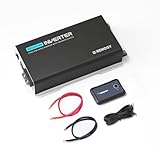
Renogy 2000W 12V Pure Sine Wave Inverter with UPS Transfer Switch
It covers the microwave setup, adds Bluetooth and an uninterruptible power supply (UPS) style transfer, is certified to UL 458 and comes with cables. The smaller relay is the main trade-off.

Xantrex Freedom X 2000 (817-2000)
A strong fit if you want to keep your existing converter. Its relay is rated 30 amps, and a continuous load should stay near 24 amps, 80 percent of that rating, per a breaker footnote in the manual. It is listed to the UL 458 standard, and you can select a faster transfer for sensitive digital equipment, as long as no motors, compressors or heating elements are connected.
If you would rather replace your converter too, look at an inverter charger such as the Go Power AIC-2000-12-SL. One box replaces a separate inverter, converter and transfer switch in a 30-amp coach, with a 100-amp charger and a lithium iron phosphate (LiFePO4) profile.
You select that profile on the PowerTrak display, which is sold separately. It suits a 200Ah to 300Ah lithium bank. Go Power sells it on its own website, and we did not find it on Amazon.
If you are planning a bigger power upgrade, our RV mods and upgrades guide shows where it fits, and a good RV surge protector is worth having for time on shore power. New owners can browse more in our RV gear guides.
We ran the sizing math ourselves from published specs and manufacturer pages.
Sources
Built from manufacturer manuals, spec sheets and government, university and trade association pages, opened November 2026.
Renogy: 2000W 12V Pure Sine Wave Inverter with UPS Transfer Switch · 12V Pure Sine Wave Inverter With Transfer Switch user manual · Converter, Inverter, Inverter Charger: What’s the Difference?
BoatID: Xantrex Freedom X Owner’s Guide
Xantrex: Inverters · Freedom X 1200 and 1200 Pro · Freedom X datasheet · Freedom X Owner’s Guide, Rev G
West Marine: Xantrex Freedom X 2000 Pure Sine Wave Inverter
Victron Energy: Inverter VE.Direct 250W to 1600W 120V datasheet · Inverter VE.Direct 120V manual · Phoenix Inverter VE.Direct 250VA to 1200VA datasheet (older hardware) · Wiring Unlimited: DC wiring
Skanbatt: Victron Phoenix Inverter VE.Direct manual (older hardware)
Go Power: AIC-2000-12-SL 2000W Single-Leg Advanced Inverter Charger · ASW-1800-12-TS 1800W Advanced Sine Wave Inverter
Battle Born Batteries: What Size Inverter Do I Need for My RV? · BB10012 spec sheet
Virginia Tech: Home appliance energy use, publication 2901-9014
Furrion: Greystone 1.3 cu ft built-in microwave
Dometic: Penguin II 13.5K BTU air conditioner
RV Products Shop: Dometic Penguin II 640315CXX1C0
Morningstar: Pure sine wave vs modified sine wave inverters
Samlex America: Pure Sine Wave versus Modified Sine Wave Inverters
Intertek: UL 458, Power Converters-Inverters and Systems for Land Vehicles and Marine Crafts
etrailer: Why You Shouldn’t Loop Your Inverter to Your Converter
ResMed: What do I need to run my sleep apnea machine while camping?
US Food and Drug Administration: Tips about medical devices and natural disasters
RV Industry Association: Technician Path and Curriculum
National RV Training Academy: RVTAA Certification: Why It Matters