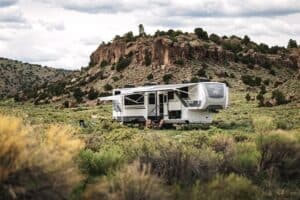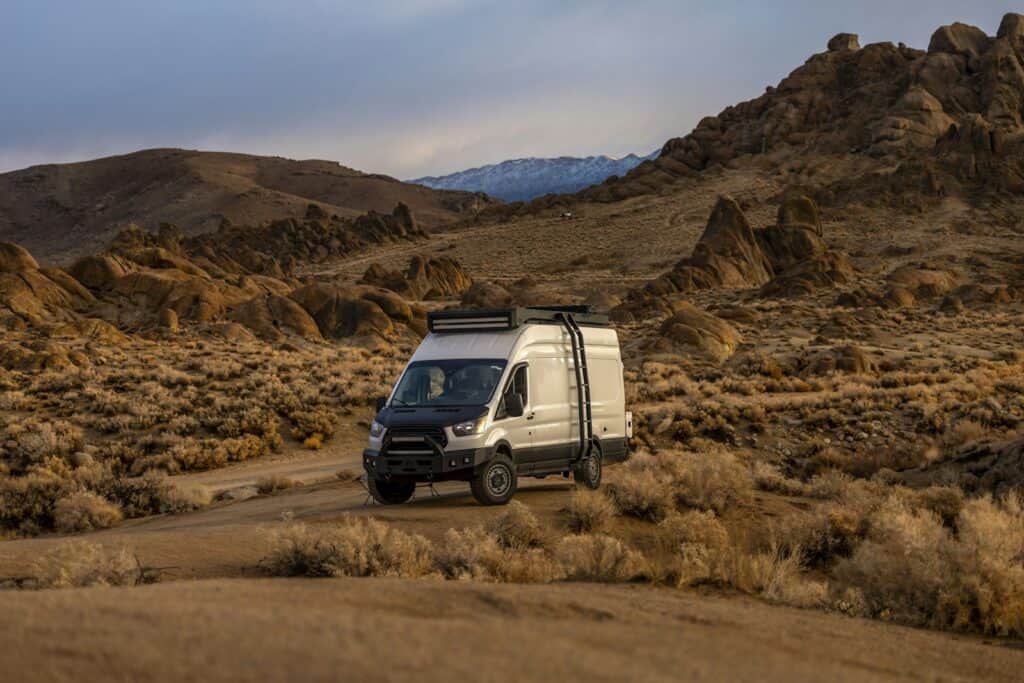
A Class B RV, also called a camper van, is the smallest type of motorhome: a van with a bed, a kitchen, and usually a bathroom built inside, on a chassis such as the Ram ProMaster, Mercedes-Benz Sprinter, or Ford Transit. Most are about 17 to 24 feet long and sleep two, and starting list prices in the builder lineups we checked ran about $122,000 to $295,000 as of November 2026, with some vans outside that range.
The short verdict is that a Class B suits one or two people who travel often and care more about easy driving than living space. For a family, or for anyone chasing the lowest price, it is usually the wrong class.
What is a Class B RV?
A Class B starts as a van built by an automaker. An RV builder then fits the living space inside the van’s original shell, with no wider body section added behind the cab. That is the real test of the class, more than its length or its price.
You will also see these vehicles called camper vans, conversion vans, travel vans, and adventure vans. They all describe the same basic idea.
Inside, expect a bed, a compact kitchen, and, on most models, a wet bath. A wet bath is one waterproof room where the shower, toilet, and sink share the same space, so the whole room gets wet when you shower.
This page covers the Class B on its own. For fuel, towing, and campsite fit across all three motorhome classes, see our Class A vs B vs C guide.
Which chassis are Class B RVs built on?
Three vans underpin every Class B model in this guide, and the choice affects the price, the fuel you buy, and how the van drives. A chassis is the base vehicle: the frame, engine, and drivetrain the RV builder starts with.
| Chassis | Example engine | Drive | Worth knowing |
|---|---|---|---|
| Ram ProMaster | 3.6L V6 gas, 276 horsepower | Front-wheel drive | 21-inch cargo floor height, helped by front-wheel drive |
| Ford Transit | 3.5L EcoBoost V6 gas, 310 horsepower (Jayco Solstice) | All-wheel drive on the Thor and Jayco models below | All-wheel drive without a diesel engine |
| Mercedes-Benz Sprinter | 2.0L four-cylinder twin-turbo diesel, 211 horsepower (Jayco Terrain) | All-wheel or rear-wheel drive, depending on the model | Has a separate tank for diesel exhaust fluid (DEF) as well as fuel |
Thor’s 2027 lineup shows the usual price order. Its ProMaster vans cost the least, its Ford Transit vans sit in the middle, and its Sprinter vans cost the most.
Pick the chassis for how you will use the van, not for the badge. All-wheel drive helps only if you will really use it on rough roads or in bad weather.
How big is a Class B, and how many does it sleep?
The shortest current model we found is under 18 feet, and the longest Sprinter floor plans run past 24. The Winnebago Travato is 6’9″ wide and 9’4″ tall, and the Roadtrek Play is 6’11” wide without mirrors. Those sizes are why these vans park and drive so much more easily than other motorhomes.
Height is easy to overlook. The Airstream Interstate 19X stands 9’11” with its roof air conditioner.
Check clearance first: Measure any carport, parking garage, or low bridge on your route, because a Class B can stand 9 to 11 feet tall.
Two is the normal sleeping count. Four takes a specific floor plan, such as the Thor Sequence 20L or Tellaro 20L with the optional roof-top Sky Bunk. The Roadtrek Play SL is rated for four, or five with an optional front folding mattress.
Do not confuse seats with beds. The Airstream Interstate 24GL seats up to 9 on the rear-wheel-drive version and still sleeps only 2.
What current Class B models look like
This table shows a spread of current models across all three chassis, using specs and starting prices from each maker’s own pages. All are 2027 models except the Travato, whose model year Winnebago’s pages do not state.
| Model | Chassis | Length | Sleeps | Fuel | Starting price |
|---|---|---|---|---|---|
| Jayco Comet | Ram ProMaster 1500 | 17’10” | 2 | Gas | $122,175 |
| Roadtrek Play | Ram ProMaster 3500 | 20’9″ | 2 (3 with optional mattress) | Gas | $141,375 |
| Thor Tellaro | Ram ProMaster 3500 | 20’11” | 2 (up to 4 on the 20L with optional Sky Bunk) | Gas | $161,560 |
| Winnebago Travato | Ram ProMaster | 21′ | 2 | Gas | $183,783 |
| Thor Talavera | Ford Transit T-350 all-wheel drive (AWD) | 19’8″ | 1 or 2, by floor plan | Gas | $189,560 |
| Jayco Solstice | Ford Transit AWD 350HD | 22′ | 2 | Gas | About $195,000 |
| Thor Sanctuary | Mercedes-Benz Sprinter 3500 AWD | 19’9″ or 24’6″ | 1 to 3, by floor plan | Diesel | $202,860 |
| Airstream Interstate 19X | Mercedes-Benz Sprinter 2500 AWD | 20’1″ | 2 | Diesel | $242,400 |
Read the floor plan as well as the model name, because beds, baths, and sleeping counts change within a single model line. Jayco also lists a mandatory Customer Value Package on these models, so ask whether a quote includes it.
How much does a Class B RV cost?
Class B RVs are often quoted at an average cost of $100,000 to $150,000. Only the cheaper end of today’s lineup fits that. Most of the vans in the table above start well over it, and Airstream’s Interstate 24GTX and 24GLX sit at the top of the lineups we checked.
Vans outside those lineups can land on either side. Camping World’s regular price for two entry-level vans, the Thor Freedom Elite 17D and Coleman 17D, was in the mid-$70,000s as of May 2026.
Specialty vans can go higher: One 2026 Storyteller Overland Beast Mode XO showed a $360,925 MSRP (manufacturer’s suggested retail price) on a dealer’s site when we opened it in November 2026.
Starting price is not out-the-door price, either. MSRP typically leaves out freight, taxes, title, license, and dealer prep. Required packages and options add up fast: Jayco’s Terrain starts at $203,625, while the 19YG floor plan shows $223,118, and its page lists a mandatory $19,125 Customer Value Package.
The sticker can also be far from what a dealer will take. One 2026 Travato 59G on a dealer’s site showed a $191,487 MSRP and a $141,995 sale price when we opened it in November 2026, with 1,507 miles on the van. That is one listing, not a rule, but it shows how much room can exist.
Never pay list price without getting quotes from a few dealers first.
What are the pros and cons of a Class B RV?
The trade-off is simple: You give up space and get easy travel. Here is how that plays out.
Pros
- Drives like a van, not a bus
- Shorter models fit a normal parking space
- Best fuel economy of the three motorhome classes
- Fits more campsites than a larger motorhome
- Some have trailer hitches rated at 5,000 to 6,000 pounds, though cargo, water, and passengers reduce how much you can tow
- All-wheel drive is available on Transit and Sprinter models
Cons
- Usually sleeps only two
- Can cost more than a larger Class C
- Most have no slide-outs to widen the interior
- Very little exterior storage
- Almost always a wet bath
- Small water and waste tanks
The tanks deserve a closer look. Fresh water capacity is 18 gallons on the Travato, 20 on the Interstate 19X, and 37 on the Roadtrek Play, while black tanks (toilet waste) hold just 8.5 to 12 gallons across those three.
That means more frequent stops to refill and dump, especially if you use the shower. Space is just as tight, so every item has to earn its place. Our beginner accessories guide helps you sort out what you really need.
Class B vs B+ vs Class C: What’s the difference?
Class B+ is not an official class. The RV Industry Association (RVIA) defines only three motorhome types, A, B, and C, so B+ is a marketing term and its meaning varies by builder.
Thor shows how loose the label is. Its 2027 Compass AWD model page calls the RV a Class B+, while its motorhome lineup files the same model under Class C.
| Feature | Class B | Class B+ | Class C |
|---|---|---|---|
| Body | Original van shell | Custom coach body on a van or cutaway chassis | Wider body attached to the original cab |
| Typical length | Shortest of the three | About 23 to 26 feet | About 25 to 35 feet |
| Typical sleeping | Two | Two to four, by floor plan | Up to 8 |
| Bathroom | Wet bath | Larger wet bath or a dry bath on some models | Dry bath on many models, wet bath on some small ones |
| Slide-outs | Rare | On some models | Common |
| Lowest price in Thor’s 2027 lineup | $146,160 (Rize, Scope) | $172,900 (Compass AWD) | $123,060 (Four Winds) |
A cutaway chassis is the engine, drivetrain, frame rails, and cab with no rear body, so a builder can attach a wider coach. A dry bath keeps the shower separate from the toilet and sink. Many Class C models also add a bed in the cab-over space above the driver.
Look at that last row again. In Thor’s lineup, the smallest class costs more to enter than the bigger Class C.
If you need beds for kids, or simply want the most space per dollar, choose a Class C. If you like the idea of a van but cannot live with a wet bath, look at a B+.
Who does a Class B RV suit?
A Class B fits a fairly narrow group very well, and everyone else only so-so. These are the buyers who tend to get their money’s worth.
- Couples and solo travelers: Two people is what these vans are built around.
- Frequent road trippers: If you move every day or two, short setup and easy parking matter more than floor space.
- Drivers nervous about big rigs: A van is a far smaller step up from a car or SUV.
- People without RV storage at home: Shorter models are easier to fit into a normal parking space, though you should check local rules.
It is a poor fit for families who need four or more real beds, for anyone who stays put for weeks at a time, and for buyers who want the cheapest way into a motorhome.
If you would only use it a few weekends a year, a new Class B is not worth the money.
Starting prices were current when opened in November 2026 and change often, so confirm them with a dealer before you budget around them.
Rent a Class B before you buy one
Six figures is a lot to spend on a guess about whether you can live in a van. Book a Class B for several nights, make the bed up every day, use the wet bath, and dump the tanks yourself. A few days will tell you more than any spec sheet.
Our guide to renting before you buy explains how to make that test trip count, and our RV rental cost guide shows what to budget beyond the nightly rate. To find a van, start with our comparison of rental platforms.
Sources
Researched from manufacturer pages, industry sources and dealer pages, opened November 2026.
Go RVing: Camper Vans: Class B Motorhomes · Compare RVs · Class C Motorhomes
Thor Motor Coach: Class B Vans · Tellaro · Sequence 20L · Talavera · Sanctuary · Compass AWD · Motorhome lineup · Class C Motorhomes · Four Winds 19Z · How Much Can My RV Tow?
Jayco: Class B Motorhomes · 2027 Comet · 2027 Comet 18L · 2027 Solstice · 2027 Solstice 21T · 2027 Terrain 19YG
Airstream: Interstate Touring Coaches · Interstate 19X Specifications · Interstate 24GL
Roadtrek: Roadtrek Models · 2027 Play Sell Sheet
Winnebago: Camper Vans · Travato · Travato Specifications
Ram: Ram ProMaster FAQ
Stellantis Media: What’s New for 2026: Ram ProMaster
RV Industry Association: Membership information packet
RV Universe: Class B vs. Class B+ Motorhomes
RV Travel: Clearing Up the Confusion on Class B, B+ and C Vans
Camping World: Class B vs Class C RV · Most Affordable Class B RV
Lazydays: How Many Miles Per Gallon Can You Expect from an RV?
Campers Inn RV: 2026 Winnebago Travato 59G listing · 2026 Storyteller Overland Beast Mode XO listing