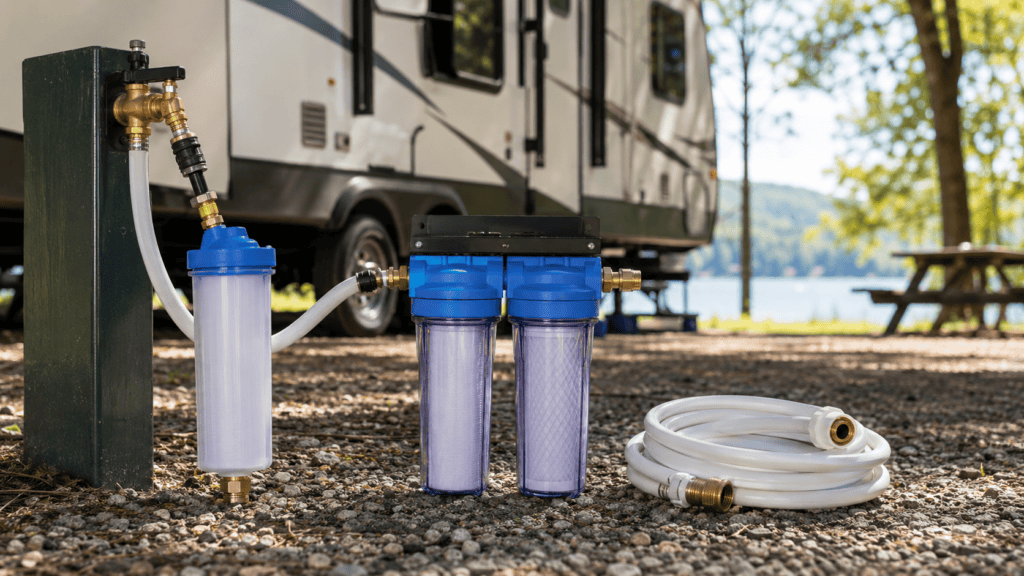
The best RV water filter for most people is a two-stage canister system: it removes sediment, chlorine, bad taste, and cysts while keeping strong water pressure, for around $100 to $200. A simple inline filter is fine for occasional weekend trips, and a reverse-osmosis or under-sink unit is the pick if you want genuinely pure drinking water.
There is no single type or size of RV water filter: the right one depends on how you travel. In a hurry? Here is our top pick for each kind of RVer. The rest of this guide explains why.
| Best for | Our pick | Price |
|---|---|---|
| Most RVers (best overall) | Two-stage canister system | $100 to $200 |
| Weekend and budget | Camco TastePURE inline | $15 to $20 |
| Full-timers and heavy use | Clearsource Premier system | $300 and up |
| Taste and odor on a budget | Culligan RV-800 inline | Around $25 |
| Pure drinking water | Waterdrop under-sink or RO | $130 and up |
Campground and city water is safe to drink far more often than not, but “safe” and “good” are different things. RV parks vary wildly: one has clean, clear water, and the next tastes of chlorine, runs cloudy with sediment, or carries whatever has been sitting in an old spigot all summer. A water filter protects both your family and your plumbing, and which one you need comes down to how you travel and how picky you are about what comes out of the tap. Below are the types, the best filter for each kind of RVer, and how to choose.
What does an RV water filter do?
An RV water filter cleans the water as it enters your rig, trapping the things you do not want reaching your tank, your pipes, or your glass. A basic filter catches sediment (sand, rust, grit) and reduces chlorine and the taste and smell that come with it. Better filters go further and remove cysts, lead, volatile organic compounds, and other contaminants, and the most thorough systems strip out nearly everything dissolved in the water. What separates a $20 filter from a $400 one is simply how fine it filters and how much it removes.
Types of RV water filters
There are five common types, and they climb in price, filtration, and installation effort together. Most RVers land on one of the first three.
| Type | Removes | Typical price | Best for |
|---|---|---|---|
| Inline (disposable) | Sediment, most chlorine and taste | $15 to $30 | Occasional and weekend trips |
| Single canister | Sediment, chlorine, taste and odor | $70 to $120 | Frequent trips, better flow |
| Two-stage canister | Above plus cysts and VOCs | $100 to $500 | Full-timers and most regular RVers |
| Under-sink | Fine sediment, most contaminants (drinking tap only) | $130 to $250 | Pure water at one tap |
| Reverse osmosis | Nearly everything, including arsenic and fluoride | $230 and up | Bad-source water, maximum purity |
The key number is the micron rating, which is how small a particle the filter can catch. A lower number filters finer: an inline filter runs about 20 microns, a two-stage canister drops to roughly 0.5 microns on its second stage, and reverse osmosis reaches 0.0001 microns, fine enough to remove dissolved chemicals. Lower is more thorough, but also slower and pricier, so the goal is matching the filtration to your water, not buying the finest filter you can.
The best RV water filters
Here are our picks by the kind of RVer you are, from the simplest weekend setup to a full drinking-water system. Start at the one that fits how you travel.
Best overall for most RVers: a two-stage canister system
For anyone who travels more than a few times a year, a two-stage canister system is the best balance of everything that matters. The first canister catches sediment down to about 5 microns, and the second uses carbon to take out chlorine, taste, odor, cysts, and VOCs down to around 0.5 microns. Because the canisters are wide, water flows through at 3 to 4 gallons a minute, so you keep real pressure at the tap instead of the trickle a clogging inline filter gives you. You replace the cartridges once or twice a season rather than tossing the whole unit.
Pros
- Removes far more than an inline filter
- Strong, steady water flow
- Cheaper per gallon over time (replace cartridges only)
Cons
- Costs more up front
- Needs a spot to mount and a hose connection
Two-stage RV canister filter system
Sediment plus carbon filtration with strong flow, replaceable cartridges, and the range to handle most campground water. The best all-around choice for regular RVers.
Check price ›Best budget and quick pick: a TastePURE inline filter
If you camp a handful of times a year, an inline filter does the essential job for the least money and zero setup: you screw it onto your drinking-water hose and you are done. It knocks out sediment and most of the chlorine taste, which is 80 percent of what most people are bothered by. The trade-offs are that it filters coarsely (around 20 microns), it slows your flow as it clogs, and you throw the whole thing away every few months. For occasional trips, that is a fair deal.
Camco TastePURE inline RV water filter
The default inline filter: cheap, screws onto your hose, and cuts sediment and chlorine taste with no installation. Replace it every few months.
Check price ›Best for full-timers and heavy use: a premium canister system
If you live in your rig or travel most of the year, a premium canister system built with stainless fittings and larger housings is worth the jump. It gives you the same two-stage or three-stage filtration with a higher flow rate (around 6 gallons a minute) and hardware that holds up to constant connect-and-disconnect. It costs the most of the canister options, but spread over years of daily use it is the one full-timers rarely regret.
Clearsource premium RV water filter system
Heavy-duty stainless build, high flow, and multi-stage filtration for people who use their water system every day. The long-haul choice.
Check price ›Best for taste and odor on a budget: Culligan RV-800
If your only real complaint is that campground water tastes and smells of chlorine, and you do not want to spend much, an activated-carbon inline filter aimed at taste is all you need. The Culligan RV-800 is a long-running favorite for exactly this: cheap, simple, and effective at making water taste clean, even if it does not remove the finer contaminants a canister system would.
Culligan RV-800 inline filter
An inexpensive activated-carbon filter aimed squarely at chlorine taste and odor. The cheap fix when water just tastes bad.
Check price ›Best for pure drinking water: an under-sink or reverse-osmosis unit
If you want water as clean as the best home filter, or you regularly fill from wells and sources you do not trust, put a fine under-sink or reverse-osmosis system at your kitchen tap. These filter down to a fraction of a micron (reverse osmosis removes even dissolved chemicals like arsenic and fluoride) and give you genuinely pure drinking water. The catch: they protect only the tap they are installed on, not your whole rig, and they cost and flow accordingly, so most people pair one with a whole-RV filter rather than using it alone. For a deeper look at drinking-water filtration, including how reverse osmosis and under-sink systems compare, see our sister site DrinkingWaterFilter.com.
Waterdrop under-sink or reverse-osmosis system
Ultra-fine filtration at your kitchen tap for near-pure drinking water. Best paired with a whole-RV filter, since it protects one faucet, not the plumbing.
Check price ›How to choose an RV water filter
Four things decide which filter is right for you. Run through them and the choice usually makes itself.
- How often you travel A few weekends a year points to an inline filter. Frequent trips or full-timing justify a canister system you maintain instead of replace.
- What is wrong with your water Just bad taste and chlorine? An activated-carbon filter fixes it cheaply. Sediment, cysts, or sketchy sources call for a two-stage canister or reverse osmosis.
- How much flow you need Inline filters slow your water as they clog. If weak pressure drives you crazy, a wider canister system keeps 3 or more gallons a minute flowing.
- Whether you want certification For health claims (removing cysts, lead, or bacteria), look for NSF or independent certification rather than vague “reduces contaminants” wording. It is the difference between marketing and proof.
How to install and maintain your filter
Inline filters need no installation: screw one end onto the campground spigot or your drinking-water hose and the other onto the hose running to your RV, and you are filtering. Canister systems mount in a storage bay or hang near the water inlet and connect inline on the hose, a job most owners can do with basic tools in under an hour. Whatever you use, replace the cartridge on schedule (every few months for inline, once or twice a season for canisters), because a clogged, neglected filter is worse than none: it slows your water and can harbor the very bacteria you were trying to keep out.
The bottom line
Match the filter to how you travel. Weekend RVers are well served by a cheap inline filter, and if taste is the only problem, an activated-carbon one like the Culligan RV-800 fixes it for around $25. Regular travelers and full-timers should step up to a two-stage canister system, the best all-around choice for protection and flow, and go premium if you use your water daily. Add an under-sink or reverse-osmosis unit at the kitchen tap only if you want truly pure drinking water. Any of them beats drinking straight from an unknown campground spigot.
Kitting out the rest of your rig? See our RV gear guides for what is worth buying and what is not.