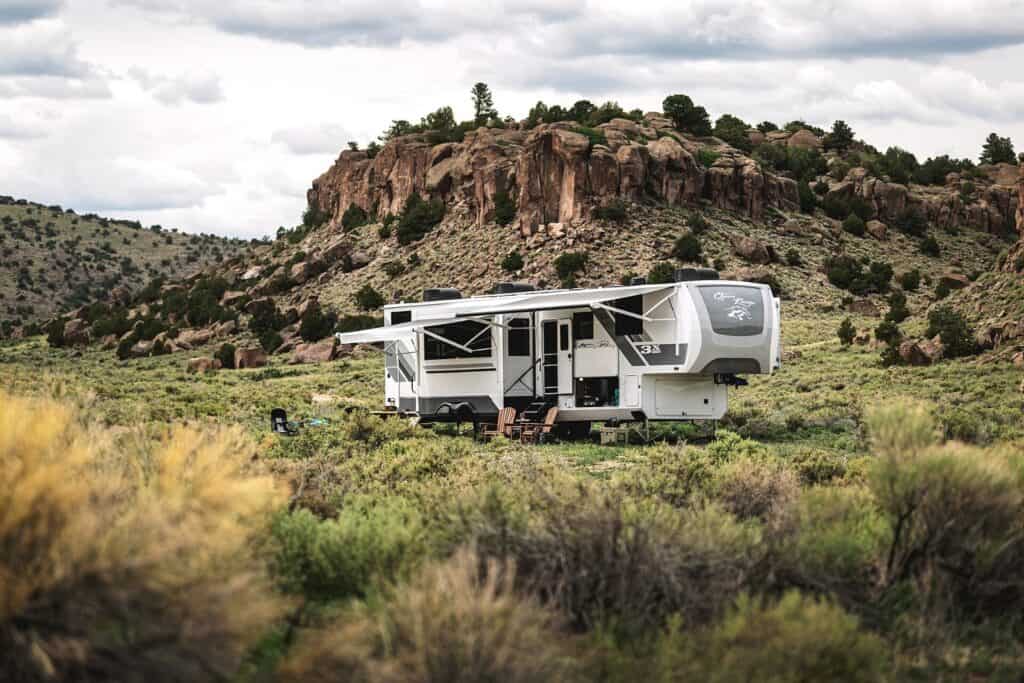
Most buyers should choose a travel trailer, because it asks far less of the truck. Jayco’s 2027 Jay Flight 245BHS travel trailer puts 640 pounds on the hitch when empty, while its 2027 Eagle SLE 28RKS fifth wheel puts 1,550 pounds on the truck.
A fifth wheel is the better buy if you already own, or plan to buy, a pickup with real payload (what the truck can carry) to spare, and you want a steadier tow and a split-level layout with separate living spaces. That usually means long stays or heavy use.
If the truck is still undecided, or you have a sport utility vehicle (SUV) or half-ton pickup you want to keep, start with a travel trailer. A half-ton is a light-duty truck such as the Ford F-150.
What Is a Fifth Wheel, and Why Is It Called That?
A fifth wheel is a towable RV that locks onto a U-shaped coupling usually mounted in the bed of a pickup. A pin box on the front of the trailer drops into that coupling, so the hitch point sits over the truck’s rear axle. A travel trailer, by contrast, connects to a hitch at the very back of the tow vehicle.
The name is older than the RV. Carriages in the 1800s had a horizontal wheel on the front axle that let it pivot, and the round hitch design that came from it kept the “fifth wheel” label. The device in your truck bed is the actual fifth wheel, not anything on the trailer.
Travel Trailer vs Fifth Wheel at a Glance
The two types overlap in length and floorplans, so the real differences come down to where the weight lands and what the truck has to carry. The height row below reflects the eight current models listed later in this guide, and the pros and cons after the table show how a fifth wheel stacks up against a travel trailer.
| Factor | Travel trailer | Fifth wheel |
|---|---|---|
| Hitch location | Rear of the tow vehicle | Usually in the pickup bed, over the rear axle |
| Weight on the truck | About 10 to 15 percent of loaded trailer weight | About 15 to 25 percent, and some sources say up to 30 |
| Tow vehicle | Car, SUV or truck, depending on weight | Usually a pickup |
| Typical length | 20 to 40 feet | 25 to 40 feet |
| Height of models below | 9 feet 7 inches (9’7″) to 11 feet 2 inches (11’2″) | 12 feet 2 inches (12’2″) to 13 feet 4 inches (13’4″) |
| Interior | Single-level living | Split-level, with steps |
Pros of a fifth wheel
- Hitch sits over the truck’s rear axle, which steadies the tow.
- Split-level design separates living and sleeping areas.
- Basement pass-through storage holds large, bulky items.
Cons of a fifth wheel
- Usually requires a pickup, and the hitch takes up the bed.
- Heavy pin weight (the trailer weight resting on the hitch in the truck bed) uses up truck payload quickly.
- Taller body needs more care around branches and low clearances.
- Interior steps can be a problem for some campers.
Weights, Heights and Prices of Current Models
These are current models with maker figures, and prices are as of November 2026. Unloaded Vehicle Weight (UVW) is the weight as built at the factory, and gross vehicle weight rating (GVWR) is the most the trailer may weigh fully loaded. Prices are the manufacturer’s suggested retail price (MSRP) unless marked “From,” which means a starting price. Our guide to the best RV brands shows who builds what.
Travel Trailers
Dry (empty, as built) hitch weight on these four runs from about 10 to 13 percent of UVW. Winnebago labels its weight dry weight, and Airstream labels its figure base weight. Height tops out near 11 feet. The Airstream price is where the Flying Cloud line starts, not a price for this floorplan.
| Model | UVW (pounds) | Hitch weight (pounds) | GVWR (pounds) | Length | Height | Price |
|---|---|---|---|---|---|---|
| Jayco Jay Flight 245BHS (2027) | 5,555 | 640 | 7,200 | 28’7″ | 10’6″ (11’0″ with air conditioner) | $34,643 |
| Winnebago Micro Minnie 2108DS | 4,426 | 476 | 5,500 | 22’5″ | 10’5″ | From $45,010 |
| Grand Design Imagine 2800BH (2027) | 7,185 | 746 | 10,195 | 32’0″ | 11’2″ | $62,522 |
| Airstream Flying Cloud 30FB Bunk (2027) | 6,700 | 900 | 8,800 | 31’2″ | 9’7″ with air conditioner | Line from $115,900 |
Fifth Wheels
Dry pin weight on these four runs from 15 to 19 percent of UVW. The Eagle SLE length is pin to bumper. Forest River does not show a price on its floorplan page, and the Keystone MSRP comes from a dealer listing. Keystone’s weight is its shipping weight, and neither Forest River nor Keystone prints a GVWR, so those two are weight plus carrying capacity.
| Model | UVW (pounds) | Pin weight (pounds) | GVWR (pounds) | Length | Height | Price |
|---|---|---|---|---|---|---|
| Jayco Eagle SLE 28RKS (2027) | 8,175 | 1,550 | 9,995 | 29’8″ | 12’2″ (12’6″ with air conditioner, 13’1″ with a second) | $57,893 |
| Forest River Rockwood Signature 281SRK (2027) | 7,733 | 1,280 | 9,875 | 29’4″ | 13’2″ | Not shown by maker |
| Grand Design Reflection 150 270BN (2027) | 8,398 | 1,256 | 9,995 | 29’11” | 12’9″ | $84,037 |
| Keystone Montana High Country 300RK (2027) | 12,540 | 2,055 | 15,700 | 34’11” | 13’4″ | $106,133 |
What the Dry Numbers Leave Out
UVW means different things at different makers. Jayco says its UVW does not include cargo, fresh water, propane, occupants, options or dealer-installed accessories, while Airstream says its base weight includes batteries and liquefied petroleum (LP) gas, which is propane. Forest River goes further and calls its UVW an estimated average.
Cargo, water and options can also change the stated hitch weight, so the figures above are not what you will tow. Purdue Extension warns that a load placed behind the axle can make a trailer’s tongue lift up on the hitch, so treat dry hitch weight as a reference, not a guaranteed minimum.
Two fifth wheels with the same limit can also load a truck very differently. The Reflection 270BN and the Eagle SLE 28RKS share a 9,995-pound GVWR, yet the Eagle’s dry pin weight is 294 pounds higher. Compare pin weight between floorplans, not just overall weight.
What Truck Does Each Need?
A travel trailer can be towed by a car, SUV or truck that is rated for it. A fifth wheel usually needs a pickup, though a flatbed or medium-duty truck can also carry the hitch, which may take a custom install. Most need a full-size truck, though some midweight models can work with half-tons. For most fifth wheels, start at a three-quarter-ton, a heavier truck such as the Ford F-250.
Payload Is the Number That Stops You
Payload usually runs out before the tow rating does. That figure covers people, cargo and options, and pin weight counts against all of it. The exact figure for your truck is on the sticker inside the door jamb, not in a brochure.
Truck names tell you little here. Ram’s 2026 chart lists up to 3,600 pounds of payload for a Ram 2500 with the high-output Cummins diesel, but the same engine drops to 2,010 pounds in a Crew Cab 4×4 with an 8-foot bed and a 9,900-pound GVWR. Ford’s 2026 guide tops out at 2,440 pounds for an F-150, so a half-ton can out-carry a three-quarter-ton.
Ram’s footnote also states that “Trailer Weight and Payload Rating are mutually exclusive.” In other words, the biggest tow number and the biggest payload number are not a package you get together. Ford’s tow ratings likewise assume a 150-pound driver and passenger, not a truck full of people and gear.
Worked Examples: Pin Weight vs Payload
Sources disagree on how much of a loaded fifth wheel lands on the truck. Ford uses 15 percent, CURT and Keystone say 15 to 25 percent, and GMC says 15 to 30 percent. As an estimate, these examples scale each trailer’s own dry hitch share up to its GVWR, which assumes the load keeps the same balance.
The Eagle SLE 28RKS is 1,550 divided by 8,175, or 19 percent. Applied to its GVWR, 9,995 times 0.19 is about 1,899 pounds on the truck.
Next, subtract what else rides in the truck. Ram’s footnote, which follows SAE International’s J2807 towing standard, allows 300 pounds of passenger weight, 100 pounds of options weight and 250 pounds of fifth-wheel trailering equipment, or 650 pounds in total. Your real cargo comes on top of that, so the margins below are before cargo.
That leaves 2,440 minus 650, or 1,790 pounds, on the best-case F-150, so the trailer runs 109 pounds over. CURT says hitches can weigh 130 pounds or more, and a true 130-pound setup would leave just 11 pounds to spare, which almost any real cargo uses up. On an F-150 with the 2.7-liter engine, whose 1,775-pound figure leaves 1,125 pounds, the same trailer runs 774 pounds over.
| Trailer | Truck payload (pounds) | After passengers, options and hitch allowance | Estimated loaded hitch weight | Estimated margin |
|---|---|---|---|---|
| Eagle SLE 28RKS fifth wheel | 2,440 (F-150, 3.5-liter EcoBoost) | 1,790 | 1,899 | 109 over |
| Eagle SLE 28RKS fifth wheel | 1,775 (F-150, 2.7-liter) | 1,125 | 1,899 | 774 over |
| Imagine 2800BH travel trailer, 10.4 percent dry share | 2,440 (F-150, 3.5-liter EcoBoost) | 1,965 | 1,060 | 905 to spare |
| Imagine 2800BH travel trailer, 15 percent | 2,440 (F-150, 3.5-liter EcoBoost) | 1,965 | 1,529 | 436 to spare |
| Montana High Country 300RK fifth wheel | 3,600 (Ram 2500 high-output diesel maximum) | 2,950 | 2,575 | 375 to spare |
| Montana High Country 300RK fifth wheel | 2,010 (Ram 2500 high-output diesel, Crew Cab 4×4, 8-foot bed, 9,900-pound GVWR) | 1,360 | 2,575 | 1,215 over |
The travel trailer rows use a 475-pound deduction, since Ram’s footnote allows 75 pounds for a conventional hitch instead of 250. The first row uses the Imagine’s 10.4 percent dry share (746 divided by 7,185), and the second uses 15 percent, the top of the usual 10 to 15 percent range (10,195 times 0.15 is about 1,529). The Montana rows use its 16.4 percent dry share (2,055 divided by 12,540).
Notice that the Imagine’s GVWR is 200 pounds above the Eagle’s, yet it keeps an estimated 436 to 905 pounds to spare on the same truck. The Eagle, by contrast, runs about 109 over at its dry share.
Fifth-wheel shares can move too, since the usual range is 15 to 25 percent. Across that range, the Eagle on the best-case F-150 lands between 291 to spare and 709 over, and the Montana on the 3,600-pound Ram lands between 595 to spare and 975 over.
Tow ratings can also stop a pairing, and Ford lists fifth-wheel ratings separately from conventional ones. Its highest fifth-wheel rating for the 2.7-liter F-150 is 8,300 pounds, so the Eagle’s 9,995-pound GVWR exceeds it by 1,695 pounds. For the 3.5-liter EcoBoost, fifth-wheel ratings run from 8,000 to 10,800 pounds by configuration, so the Eagle clears only some of them.
The Imagine has more room here, because Ford’s conventional ratings for that engine start at 10,500 pounds, above its 10,195-pound GVWR. Ram’s chart gives ratings for the Ram 2500 high-output diesel from 14,630 to 20,000 pounds by configuration, so the 15,700-pound Montana clears most of them, but not the two lowest.
These payloads are chart figures, not your truck. Run the same math with your own door sticker, and weigh the loaded rig before relying on it.
Short Beds and Frontal Area
Bed length matters too. An 8-foot bed is ideal for a fifth wheel, because a trailer on a fixed hitch can hit the cab in tight turns on a shorter one. Sliding hitches, such as PullRite’s SuperGlide, exist for this reason. Ford’s F-150 guide goes further, warning that most fifth-wheel trailer designs are not compatible with its 5.5-foot box.
Ford also limits trailer frontal area on the F-150, at 65 square feet for trucks with tow ratings above 7,700 pounds and 75 square feet for fifth wheels. An 8-foot-wide trailer reaches 65 square feet at a face just over 8 feet tall (65 divided by 8), so check this on tall travel trailers. Ford warns that exceeding the limits may significantly reduce performance.
How Much Does Each Hitch Cost?
The hitch gap can be small, because a safe travel trailer setup is not free either. Ford says not to exceed 5,000 pounds on an F-150 without a weight-distribution system, and every travel trailer listed here can pass that when loaded. Prices below are as of November 2026.
| Item | For | Price |
|---|---|---|
| Typical fifth wheel hitch, CURT’s range | Fifth wheel | $350 to $1,200, or $750 to $1,700 installed |
| Andersen Ultimate 5th Wheel Connection, rail mount, rails required | Fifth wheel | $884.99 |
| Andersen Ultimate 5th Wheel Connection, gooseneck mount | Fifth wheel | $1,219.99 |
| Equal-i-zer weight distribution with 4-point sway control, 10,000 pounds | Travel trailer | $783.75 at etrailer |
Three details are worth checking before you buy. Rails are the standard mount, and without factory puck holes (prebuilt mounting points in the bed) you will need to drill into the bed, while some trucks offer a prep package (Ram’s has a factory-installed crossmember). A gooseneck mount skips the rails and locks onto a factory gooseneck ball in the bed.
Hitch weight also comes out of payload, so Andersen’s 37-pound aluminum gooseneck mount saves 93 pounds against a 130-pound hitch. Its steel rail mount head weighs 40 pounds before rails. The Equal-i-zer above is rated for 10,000 pounds gross and 600 to 1,000 pounds on the hitch, so it does not suit every trailer listed here.
Which Tows More Steadily?
A fifth wheel has the edge, and the reason is geometry. With the hitch over the rear axle, Keystone says crosswinds and buffeting have less effect, while a travel trailer hitched at the rear is more susceptible to both. CURT makes a similar point, and many owners find the setup stable and smooth.
Keep the sourcing in mind, because these are maker and industry statements rather than published measurements. The line on Keystone’s site that a fifth wheel “virtually eliminates” sway is a strong one, and it does not excuse loading mistakes. Jayco stresses balanced loading on any trailer, since load placement helps control sway.
A travel trailer can still tow well with the right gear. Ford lists Trailer Sway Control as standard on the F-150, and weight-distribution hitches such as the Equal-i-zer build sway control in. If sway starts, Ford’s advice is to activate the trailer brakes by hand at the brake controller and not to apply the tow vehicle’s brakes, which can make sway worse.
Which Costs More to Buy?
Fifth wheels cost more, and the premium looks consistent inside a brand. By the MSRP on each floorplan page, Jayco’s Eagle SLE 28RKS lists $23,250 above the Jay Flight 245BHS, and Grand Design’s Reflection 270BN lists $21,515 above the Imagine 2800BH. If you also need a bigger truck, budget for that separately.
Do Not Trust the Dealer’s MSRP
Here is a detail worth checking: A dealer’s listed price may not match the maker’s. One dealer showed a 2027 Jay Flight 245BHS at $39,593 MSRP and $26,999 on sale, while Jayco shows $34,643. Another showed an Eagle SLE 28RKS at a $76,909 price, not labeled MSRP, and $48,989 on sale, against the $57,893 MSRP on Jayco’s page.
Options and freight may explain part of those gaps, but the advertised “savings” means little until you compare the sale price with the maker’s number. Sale prices also move, so a Montana High Country 300RK listed at $92,995 against $106,133 MSRP is one dealer’s figure, as of November 2026, and it counts a $4,000 finance incentive. Jayco and Grand Design say their MSRPs exclude freight and dealer prep.
Rules That Can Change the Answer
A few state rules treat the two types differently. Laws change, so confirm the rules with each state you plan to drive through, not only your home state.
License Requirements
California shows why GVWR matters. The classes below are California-issued licenses, and a visiting driver over 18 can generally use a valid license from their home state. With a Class C license, a tow vehicle of at least 4,000 pounds unladen and personal use, you can tow a trailer coach (California’s term that covers a travel trailer) or fifth wheel under 10,000 pounds GVWR.
A fifth wheel between 10,000 and 15,000 pounds needs an endorsement, but a travel trailer over 10,000 pounds moves up to a noncommercial Class A. So a California license holder needs a higher class for the 10,195-pound Imagine 2800BH than for the 9,995-pound Reflection 270BN. Over 15,000 pounds, as with the 15,700-pound Montana High Country, a fifth wheel also needs the noncommercial Class A.
Texas requires a Class A license, even without a commercial driver’s license (CDL), for a combination with a gross combination weight rating (GCWR) of 26,001 pounds or more when the towed unit exceeds 10,000 pounds GVWR. Personal RV users are exempt from a CDL but may still need that license, so check this before pairing a heavy fifth wheel with a one-ton truck.
Riding in the Trailer
Some states allow passengers in a towed fifth wheel but not a travel trailer. California Vehicle Code section 21712 bars passengers from a towed trailer coach. It exempts one towed with a fifth-wheel device only if it has safety glazing in its windows and doors, an audible or visual signal a passenger can use to reach the driver, and at least one unobstructed exit that opens from inside and outside.
Camping World, citing an RV Industry Association report, lists eight such states. It also strongly discourages riding in either type because of the lack of safety features.
Height and Length
Federal rules set no height limit, and most state limits fall between 13 feet 6 inches and 14 feet. At 13’4″, the Montana High Country sits just 2 inches under the lower figure. Length limits also vary. California caps combinations at 65 feet, and cities and counties there may post a 60-foot limit.
Living with Each One
Inside, a fifth wheel’s split-level layout creates separate living spaces and more privacy, and many offer more headroom and more open layouts. The downside is the steps. A travel trailer offers single-level living, which suits campers who would rather not climb stairs, and models with several slide-outs can still feel open.
Storage leans toward the fifth wheel, thanks to the pass-through basement, but the hitch takes over the truck bed. With a travel trailer, the open bed stays free for gear and firewood. Either way, you will need to level at camp, so read our guide to RV leveling blocks, and check load ratings against our RV tires guide before a big trip.
Which Should You Buy?
Buy a travel trailer if you already own a half-ton or an SUV, you camp on weekends and shorter trips, you want the truck bed free, or stairs are a concern. It is also the safer choice if you do not yet know what your door sticker says.
Buy a fifth wheel if you will spend weeks at a time in it, you want separate living space, and your truck clears both the payload math and its tow rating with room left over. If neither option feels right, or you would rather not tow at all, compare them with motorhomes in our Class A vs B vs C guide.
Rent One before You Buy
A rental is a low-commitment way to find out whether you like the split-level steps or the single-level layout. You do not need a matching truck to try one, either. Towable delivery lets you rent a travel trailer or fifth wheel without a suitable tow vehicle, and the owner handles the drive, setup and walkthrough.
The catch is that a delivered rental tells you about the floorplan, not the tow. Our rent before you buy guide covers what to look for, and our comparison of RVshare, Outdoorsy and RVezy can help you pick a platform.
Sources
Researched from manufacturer, government, industry and dealer pages, opened November 2026.
Jayco: 2027 Jay Flight 245BHS · 2027 Eagle SLE 28RKS · 2027 Eagle SLE floorplans · Fifth wheels · What Is a Fifth Wheel · Understanding RV Weights and Their Meanings · Frequently Asked Questions About Towing an RV
Winnebago: Micro Minnie 2108DS
Grand Design: Imagine 2800BH · Reflection 150 Series 270BN
Airstream: Flying Cloud specifications · Flying Cloud 30FB Bunk specifications · Defining the Towing Acronyms UBW, GVWR, NCC
Forest River: 2027 Rockwood Signature 281SRK
Keystone RV: Montana High Country 300RK · Travel Trailer vs. Fifth Wheel · Mastering Fifth Wheel Towing
Ford: 2026 F-150 Towing Guide
Ram: 2026 Ram Heavy Duty towing and payload chart · Ram 2500 capability
GMC: Tongue weight
CURT: 5th Wheel Hitches 101
Andersen Hitches: 5th wheel catalog
PullRite: #2900 ISR Series 20K SuperGlide
etrailer: Equal-i-zer weight distribution system · Guide to Choosing the Best Truck for 5th-Wheel Towing · Is It Possible to Tow a Fifth Wheel Using a Flat Bed Cab and Chassis Truck
California DMV: Driver’s Licenses
California Vehicle Code: Section 12502 · Section 21712 · Section 35401
Texas Department of Public Safety: Classes of Driver Licenses
Federal Highway Administration: Federal Size Regulations for Commercial Motor Vehicles
Go RVing: Fifth Wheel Trailers: Spacious Comfort and Smooth Towing
Camping World: Why Is It Called a Fifth Wheel? · What States Can You Ride in a Travel Trailer or Fifth Wheel? · Can a Half-Ton Truck Tow a Fifth Wheel RV?
Purdue Extension: Keep the Trailer Connected to the Truck
SAE International: J2807 Performance Requirements for Determining Tow-Vehicle Gross Combination Weight Rating and Trailer Weight Rating
RV.com: Dodge 4500/5500
RV Industry Association: History of RVs
J.D. Power: Why Is It Called a Fifth Wheel?
RVshare: RV Rental Delivery and Setup
TruckGuider: Ram Payload Capacity Charts
RVGuide: 2027 Keystone Montana High Country 300RK
TowingSpecs: Rockwood 281SRK Specs and Weight
Dealers: Fretz RV, 2027 Jay Flight 245BHS · RVingPlanet, 2027 Eagle SLE 28RKS · Lazydays, 2027 Montana High Country 300RK
Photo: Highland Ridge RV – 3X Fifth Wheel by Anshamblen15, CC BY-SA 4.0, resized.