A used RV can be the cheaper way into RVing, but the gap is sometimes much smaller than the sticker price suggests. Buy new if you want a full factory warranty, a specific floor plan, or easier financing.
As of November 2026, Jayco listed a new 2027 Jay Flight 261BHS travel trailer at $36,006 MSRP plus a mandatory $5,250 Customer Value Package, or $41,256 before freight and dealer prep. Some dealers advertise far less: Homestead RV Center in Ohio listed a new in-stock unit at $26,988, and Bish’s RV in Omaha listed one at a $29,995 sale price.
Kunes RV Elkhorn was asking $25,995 for a used 2024 Jay Flight SLX 261BHS, a similar floor plan from Jayco’s 2024 Jay Flight SLX series. That is $15,261 below Jayco’s sticker total, but only $993 below Homestead’s price and $4,000 below Bish’s. Compare a used asking price with real advertised prices for new units, not the MSRP.
The main argument against buying used is risk, since a used RV can come with no warranty, hidden water damage, or open recalls. The rest of this guide walks through those tradeoffs so you can pick the right path for your budget.
If you are still deciding which type of RV fits your trips, start with our guide to Class A vs Class B vs Class C motorhomes. The new vs used question matters most once you know the category you want.
New vs Used RV at a Glance
Here is a quick side-by-side of the biggest differences. Each row is covered in more detail below.
| Factor | New RV | Used RV |
|---|---|---|
| Price | Highest sticker price, but some dealers advertise well below MSRP | Can be lower; compare with advertised new prices, not MSRP |
| Factory warranty | Full coverage from the date you buy | Only what remains, and only if the brand allows transfer |
| Lemon law protection | Possible in some states, usually for the chassis and drivetrain only | Rarely, with narrow exceptions |
| Choice | Pick the floor plan, colors and options | Limited to what is for sale near you |
| Financing | Often the longest terms and lowest rates | Shorter terms and higher rates as the RV ages |
| Known issues | Early defects still to be found | Early defects may be fixed, or may be hidden |
What You Get with a New RV
A new RV buys peace of mind more than anything else. You know its full history, because there is none, and the manufacturer stands behind it for a set period.
A Full Factory Warranty
Many major brands include a limited warranty plus longer structural coverage. Jayco, for example, says all of its towable products come with a 2-year limited and 3-year structural warranty. Winnebago’s 2026 towables manual lists a one-year limited base warranty and a three-year limited structural warranty.
Airstream gives its model year 2026 travel trailers a 2-year bumper-to-bumper limited warranty and a 5-year structural limited warranty, while its touring coaches get a 2-year limited warranty. Grand Design pairs a 1-year base warranty with 3-year structural and 5-year frame coverage.
Financing Is Usually Easier
Lenders tend to reward newer RVs with longer terms and lower rates. That can make a new RV’s monthly payment surprisingly close to a used one’s, even though you borrow more. The catch is that you pay interest on a larger balance for longer, so compare the total cost of the loan, not just the payment.
You Choose the Floor Plan and Options
Buying new lets you choose from a builder’s current floor plans and options, including a model whose weight suits your tow vehicle. That matters if you have a specific need (such as bunks for kids, a dry bath in a small van, or a lighter trailer for a midsize truck). Our roundup of the best RV brands is a good place to compare builders before you order.
Pros of Buying New
- Full factory warranty from day one
- Widest choice of current floor plans and options
- Longer loan terms at some lenders
- Eligible for some new-RV insurance coverages
Cons of Buying New
- Highest purchase price
- Early defects are yours to discover
- Value loss starts the day you buy
- Larger loan balance and more interest
What You Get with a Used RV
A used RV trades certainty for savings. Done carefully, that trade can leave thousands of dollars in your pocket for campground fees, gear and fuel.
Compare Real Prices, Not the Sticker
A used RV can cost much less, but the size of the discount depends on what you compare against. As of November 2026, Homestead RV Center in Girard, Ohio, listed a new 2027 Jay Flight 261BHS at $26,988 against a $40,956 dealer MSRP. Bish’s RV in Omaha, Nebraska, showed a $29,995 sale price against a $41,399 MSRP and said its sale prices include freight, dealer prep and orientation fees.
Against those prices, the used 2024 Jay Flight SLX 261BHS at Kunes RV Elkhorn in Wisconsin, asking $25,995, was $993 below Homestead and $4,000 below Bish’s. Homestead’s listing did not say whether its price covers freight or prep, so ask any dealer for an out-the-door figure before you compare.
Jayco sold the 2024 Jay Flight SLX as its own series, so the two trailers share the 261BHS floor plan code but not the same trim. A gap this small can still favor used, but it may not make up for the warranty you give up.
Used values also move with the market. J.D. Power, as reported by RV PRO, said Class C motorhome values in November and December 2024 averaged 4.7% lower than a year earlier, and values for the most recent 10 years of Standard Hitch trailers averaged 3.6% lower. Falling values help used buyers, but they also mean a new RV you buy today may be worth less when you sell.
Early Defects May Already Be Fixed
Some problems tend to surface early, such as loose trim, leaky fittings, or a slide that needs adjusting. A careful first owner may have had these handled under warranty. Ask for service records, because a stack of completed warranty repairs is a good sign, while no records at all deserves more scrutiny.
Warranty Transfer Depends on the Brand
This is where used buyers need to read the fine print. Some brands let coverage follow the RV, while others end it when the first owner sells. A two-year-old RV from a brand with transferable coverage can be a much safer buy than one from a brand without it.
Jayco says its warranty applies to the first consumer purchaser and is non-transferable, though the chassis warranty on a Jayco motorhome transfers if it has not expired. Grand Design, by contrast, announced in July 2024 that its 3 and 5-year warranties became fully transferable to later owners, starting with model year 2020.
Pros of Buying Used
- Can cost less than new
- Slower value loss from here on
- Early defects may already be repaired
- Cheaper way to learn what you like
Cons of Buying Used
- Warranty may be gone or not transferable
- Hidden water damage or neglect
- Shorter loan terms and higher rates
- Limited choice of floor plans nearby
Warranties and Lemon Laws
Warranty coverage and lemon law rights are the two biggest protections a new buyer has. Both work differently for RVs than for cars, and both shrink or disappear for most used buyers.
Factory Warranty Terms Compared
Here is how four well-known brands describe their coverage and whether it transfers. Terms change by model year, so confirm with the manufacturer before you buy.
| Brand | Base Coverage | Structural Coverage | Transfers to Next Owner? |
|---|---|---|---|
| Airstream travel trailers (2026) | 2 years bumper-to-bumper | 5 years | Yes, remaining limited coverage, with a transfer form |
| Grand Design (2020 and newer) | 1 year | 3 years, plus 5-year frame | Yes, remaining coverage |
| Jayco towables | 2 years | 3 years | No; motorhome chassis warranty can transfer |
| Winnebago towables (2026) | 1 year | 3 years | Base warranty, for the rest of the first 12 months |
Lemon Laws Often Skip the Living Quarters
The RV Industry Association notes that most states that include motorhomes in lemon laws exempt the “house half” of the vehicle. In practice, that means the engine and chassis may be protected, while the fridge, furnace and plumbing are not.
California’s lemon law is a clear example. Its definition of a new motor vehicle includes the chassis and the portion of a motor home devoted to its propulsion, but does not include any portion designed, used, or maintained primarily for human habitation.
Florida’s Attorney General lists “the living facilities of recreation vehicles” among the items its Lemon Law does not cover. A Florida RV Trade Association summary of that guidance gives examples, including the flooring, plumbing system and fixtures, roof air conditioner, furnace and generator.
Used Buyers Have Few Lemon Law Rights
Lemon laws are written for new vehicles. Florida, for instance, says its law only applies to new or demonstrator vehicles sold in the state. There is a narrow exception: If a vehicle is transferred directly from one consumer to another during the first 24 months after delivery, and both consumers use it for personal, family or household purposes, the new owner may be covered.
The FTC Buyers Guide May Not Apply
On used cars, dealers must post the FTC’s Buyers Guide, which tells you whether the vehicle is sold with a warranty or “As Is.” The rule only covers vehicles with a gross vehicle weight rating under 8,500 pounds, a curb weight under 6,000 pounds, and a frontal area under 46 square feet.
An FTC staff compliance guide says that because of those size limits, recreational vehicles generally are not covered. So do not count on a Buyers Guide window sticker when you shop for a used motorhome, and get any warranty promise in writing.
Recalls: Check Every VIN
A VIN search tells you whether a specific vehicle needs a recall repair, so check any used RV before you buy. NHTSA says recalls are issued for vehicle-related equipment such as trailers, and it counted 997 recalls in 2025 for vehicles, car seats, tires, RVs and other equipment.
Enter the 17-character VIN in NHTSA’s recall search at NHTSA.gov/Recalls. The search does have gaps: It does not show recalls more than 15 years old (unless the manufacturer offers more coverage), and it may miss very recent recalls or those from small manufacturers.
NHTSA says a local dealer will fix a recalled part for free. One exception: Federal law does not require a free remedy if the vehicle was first bought more than 15 calendar years before the recall notice (5 years for tires).
After you buy, register the RV with the manufacturer. NHTSA says manufacturers notify registered owners by first-class mail within 60 days of reporting a recall to the agency, so a second owner who never registers can miss those letters.
Ask About the Chassis and Appliances Too
On a motorhome, ask the seller for recall paperwork covering both the chassis and the living area. For any RV, it is also worth asking whether appliances (such as the refrigerator or water heater) were ever repaired under a manufacturer campaign.
Financing and Insurance Differences
The age of the RV changes what lenders and insurers will offer. Rates below are examples from individual lenders, not national averages, and they change often.
Older RVs Get Shorter Loans
Greylock Federal Credit Union, as listed in November 2026, offered RV rates starting at 8.39% APR for a term of up to 6 years on 2023 and newer models. For 2016 to 2018 models, the maximum was 5 years at rates starting at 10.39%, and for 2015 and older, 4 years at rates starting at 11.64%.
Other lenders cap age outright. Peninsula Credit Union limits its RV loans to units 15 years old or newer with 150,000 miles or less, and says rates depend on credit and vehicle mileage. If you plan to finance, check age limits before you fall for an older rig.
Some Insurance Options Favor Newer RVs
Progressive offers Total Loss Replacement on qualified new RVs, which may pay for a brand new one if the RV is totaled. It also limits its roof and pest damage coverages to motorhomes and travel trailers less than six years old. A used buyer can still get solid coverage, but a few extras may not be available.
A Note on Taxes
IRS Publication 936, for 2025 returns, says a home for mortgage interest purposes includes a house trailer, boat or similar property with sleeping, cooking, and toilet facilities. That can apply to new or used RV loans alike, but the rules are detailed, so talk to a tax professional first.
What to Check Before Buying Used
A full inspection deserves its own guide, but these checks will screen out the worst buys quickly. Consider paying a certified RV inspector for anything you are serious about.
- Signs of water damage, such as soft floors, stained ceilings, or delamination on the sidewalls
- Roof condition and sealant around vents, seams and skylights
- Open recalls for the RV and, on motorhomes, the chassis
- Whether any factory warranty remains and how to transfer it
- Service records, including completed warranty repairs
- Every appliance running on each power source it is built for, whether shore power, battery or propane (a cold water heater is a common find)
- Tire date codes and slide-out operation
Which Should You Buy?
There is no single right answer. Most shoppers fall clearly into one camp once they are honest about budget and risk.
Buy New If
Choose new if you plan to keep the RV for many years, want a specific floor plan, or would rather pay more than deal with repairs. New also makes sense if you need long financing to keep payments low, or if you value insurance extras such as total loss replacement.
Buy Used If
Choose used if this is your first RV and its asking price clearly beats what dealers advertise for a similar floor plan new. A unit from a brand with transferable coverage is a safer bet. Used also suits buyers who are handy and comfortable with basic RV maintenance.
Rent One First
The cheapest way to make this decision is to spend a few nights in an RV before you buy anything. A weekend rental shows you how a floor plan really works, how hard it is to tow or drive, and how much you will use it.
Our guide to renting before you buy explains how to get the most from a test trip. To find a model similar to the one you are considering, compare listings with our breakdown of RVshare vs Outdoorsy vs RVezy.
Sources
Researched from manufacturer, government, industry and dealer pages, opened November 2026.
Airstream: Model Year 2026 Warranty Coverage
Grand Design RV: Industry First 1-3-5 Year Transferable Warranty Program
Jayco: Frequently Asked Questions: Buying and Selling · 2X Better Warranty · 2024 Jay Flight SLX 261BHS · 2027 Jay Flight 261BHS
Winnebago: 2026 Winnebago Towables Owner’s Manual
NHTSA: Check for Recalls · Vehicle Safety Recalls Week
U.S. Code: 49 U.S.C. 30120, Remedies for Defects and Noncompliance
Federal Trade Commission: Dealer’s Guide to the Used Car Rule · Used Car Rule Staff Compliance Guidelines
Florida Attorney General: Is My Vehicle Covered?
Florida RV Trade Association: Lemon Law for Recreational Vehicles
California Civil Code: Section 1793.22
RV Industry Association: Lemon Law Policy
RV PRO: JD Power Reports Continued Decline in RV Values
Dealers: Homestead RV Center: New 2027 Jayco Jay Flight 261BHS · Bish’s RV Omaha: New 2027 Jayco Jay Flight 261BHS · Kunes RV Elkhorn: Used 2024 Jayco Jay Flight SLX 261BHS
Lenders: Greylock Federal Credit Union RV Loans · Peninsula Credit Union RV and Boat Loans
Progressive: RV Insurance Coverages
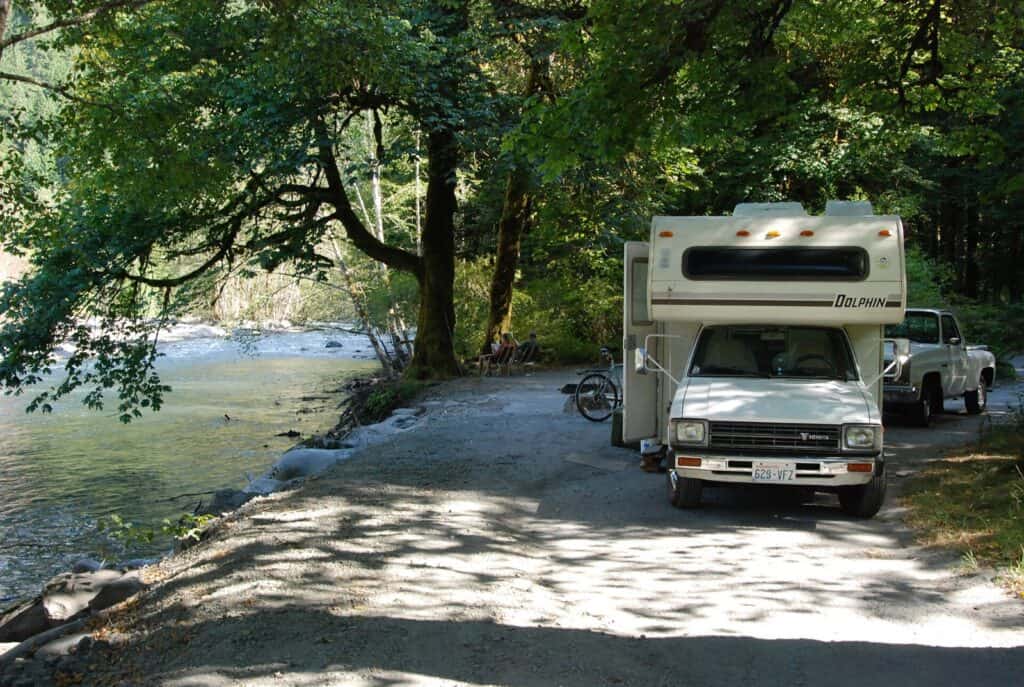
Photo: Camping, river, motorhome by Olympic National Park (National Park Service), public domain, resized.