Full-time RV living costs roughly $1,100 to $4,900 a month for a couple in our sample budgets, built from 2026 prices for campsites, fuel, food and internet, plus the latest published RV insurance averages, before health insurance and loan payments. Where you land in that range depends mostly on how you camp, how far you drive, and what you eat.
Those totals are not survey averages. They are three sample budgets we built line by line from current published prices, so you can see exactly where each dollar comes from and swap in your own numbers.
Costs vary a lot by region, season, rig type and travel style, and this page is general information, not financial advice.
What does full-time RV living cost per month?
The table below shows three sample monthly budgets for two adults. Each line uses a price from a source we checked in November 2026, and the mileage figures are our own assumptions, labeled so you can change them.
| Monthly cost | Lower | Middle | Higher |
|---|---|---|---|
| Campsite | $26 | $1,227 | $2,196 |
| Fuel | $178 | $427 | $1,191 |
| RV insurance | $88 | $88 | $88 |
| Maintenance and repairs | $83 | $125 | $167 |
| Food at home | $653 | $808 | $1,008 |
| Internet (Starlink) | $55 | $80 | $175 |
| Memberships and passes | $15 | $15 | $22 |
| Mail and legal address | 5 | 5 | 0 |
| Total before health insurance | $1,113 | $2,785 | $4,857 |
Here is what each sample assumes.
- Lower: A Bureau of Land Management seasonal permit ($180 for 7 months), 500 miles on gas at 12 mpg, the U.S. Department of Agriculture (USDA) Low-Cost food plan, and Starlink Roam 100GB.
- Middle: One Arizona resort’s fall monthly rate (electric extra), 1,000 miles on gas at 10 mpg, the USDA Moderate-Cost plan, and Starlink Roam 300GB.
- Higher: 30 nights at the $73.20 national RV site rate, 1,500 miles on diesel at 8 mpg, the USDA Liberal plan, and Starlink Roam Unlimited.
Three things are deliberately left out of those totals: Health insurance, any RV or truck loan, and your emergency fund contribution. Each can be large enough to change the picture, so we cover them separately below.
Cell phone plans, laundry, propane, entertainment and gifts are also not in the table, so add a line for them.
How much do campsites cost, nightly vs monthly?
Campsite fees are usually the biggest swing factor in a full-time RV budget. The Outdoor Hospitality Pricing Index reported an average of $73.20 per night for RV sites in June 2026.
Paying that every night for 30 nights comes to $2,196 a month, which is why paying a nightly rate every night is the costliest approach in our samples.
Monthly rates change the math. Sunrise RV Resort in Apache Junction, Arizona, is one example: Its standard site is listed at $100 a night for January to March 2027, but its monthly rate for the same period is $1,508. Sunrise is a 55+ resort that requires at least one guest per RV to be 55 or older, and it does not accept Class B vans, pop-ups or truck campers.
For May to September 2026, the standard monthly rate is $884. The resort notes that monthly guests set up electric in their own name and pay for what they use, so the utility bill is on top of the site rate.
Public land is the low end. At the Bureau of Land Management’s (BLM, the federal agency that manages public land) Imperial Dam Long Term Visitor Area, just north of Yuma, Arizona, on the California side of the Colorado River, a $180 permit covers the season from September 15 to April 15, and a 2-week stay is $40.
Spread over seven months, that permit works out to about $26 a month, though it is public land, not a full-service resort. The permit covers only September 15 to April 15, and a 14-day stay limit applies there the rest of the year.
What about camping memberships?
Memberships can cut nightly costs if they fit how you travel. Harvest Hosts lists its Classic membership at $99 a year, Boondockers Welcome (stays on private property) at $79 a year, and an All Access bundle at $179 a year, which includes a membership in Escapees, an RV club that also runs a mail service.
That is why the higher sample budget counts only the mail fee in its mail line. Harvest Hosts suggests members plan to spend about $30 at the host’s business per one-night stay, so a free overnight is not quite free.
For national parks and federal lands, the America the Beautiful pass is $80 a year for U.S. citizens and residents, and the senior annual pass is $20. Campground memberships like Thousand Trails also exist, but we could not confirm a current 2026 price, so check their site before you budget for one.
How much will you spend on fuel?
Fuel depends on three things: The price per gallon, your rig’s mileage, and how often you move. For the week of October 26, 2026, EIA reported a U.S. average of $4.269 a gallon for regular gasoline and $6.352 for on-highway diesel. Those are national averages, and prices in your area can be higher or lower.
Mileage varies by rig. Lazydays says Class A motorhomes (the big bus-style coaches) average 6 to 10 mpg, Class C motorhomes (built on a truck or van chassis, often with a bed or storage over the cab) around 10 to 15 mpg, and Class B camper vans 18 to 25 mpg.
At 8 mpg and diesel at $6.352, every 1,000 miles costs about $794 in fuel, so slowing down is one of the most reliable ways to lower your monthly cost.
What does RV insurance cost for full-timers?
Progressive reports that its countrywide average 12-month RV policy in 2024 was $594 for a travel trailer and $1,052 for a motorhome. That works out to about $50 and $88 a month. Those averages are not full-time policies, and Progressive notes that living in an RV for much of the year may call for extra coverage, so full-timers may pay more. Your price depends on the RV’s type, age and condition, how you use it, where you live, your coverage, and your driving record.
Full-timers should expect to need more than a standard policy. Progressive notes that if your RV is your permanent residence, you may need extra coverage that works like homeowners insurance, such as personal liability and medical payments.
Ask about full-timer coverage specifically when you get quotes, and check how your tow vehicle or towed car is covered.
How much should you budget for maintenance and repairs?
Maintenance is the line people underestimate, because it is lumpy. Cruise America says most RV travelers budget $1,000 to $2,000 a year for repair and maintenance, which is about $83 to $167 a month. The same page puts average RV dealership labor at $130 an hour.
A full-timer puts far more miles and nights on a rig than a weekend camper, so treat the low end with caution. Setting the money aside every month, even in months you spend nothing, means a new set of tires or a roof repair does not land on a credit card.
How much does food cost on the road?
Food is a line you control directly. The USDA’s September 2026 food plans put monthly food-at-home costs for one woman and one man aged 19 to 50 at $594.00 on the Low-Cost plan, $734.80 on Moderate-Cost, and $916.40 on Liberal.
The USDA says to add 10 percent for a 2-person household, which gives the $653, $808 and $1,008 figures in our table.
Restaurants, takeout and campground snack bars are on top of that. Shopping at larger grocery stores before you head somewhere remote, and cooking most meals in the RV, is the simplest way to keep this line steady.
What do phone and internet cost for full-time RVers?
Internet is a must for anyone working on the road. As reported by RV Mobile Internet in May 2026, Starlink’s U.S. Roam plans are $55 a month for Roam 100GB, $80 for Roam 300GB, and $175 for Roam Unlimited, and Standby Mode, the paid replacement for Starlink’s old free pause option that keeps a low-speed connection for messaging and updates, rose to $10 a month.
An October 30, 2026 report from the same site still lists Roam Unlimited at $175.
On the 100GB plan, data is slowed rather than cut off after you use your allowance. Hardware is a separate one-time cost, and SatelliteInternet.com lists the Standard dish at $349.
Starlink’s U.S. service plans page lists the same Roam prices, but confirm them at checkout. Our Starlink for RV guide covers which plan and dish fit different travel styles.
Your cell phone plan is a separate line we did not price here, because plans vary too much by carrier and household. Carrying a phone hotspot as a backup to Starlink, or the reverse, is worth considering if your income depends on staying online.
How much is health insurance for full-time RVers?
Health insurance can be the largest single bill for full-timers under 65. KFF, a health policy research group, reports that the average monthly benchmark premium for a 40-year-old in 2027, based on the second-lowest-cost silver plan on the Affordable Care Act marketplace, is $704 in the U.S., up from $625 in 2026.
For two 40-year-olds, that is $1,408 a month before any premium tax credit.
The state you pick as your legal home matters here. KFF lists 2027 benchmark premiums for a 40-year-old of $737 in Texas, $738 in Florida, and $704 in South Dakota.
What you actually pay depends on your age, income, plan and whether you qualify for tax credits, so get real quotes for your domicile state before you commit.
What do mail service and domicile cost?
Full-timers still need a domicile, meaning the state they legally call home, and a way to get mail. A forwarding address alone does not establish it; Escapees also points to steps such as a new driver’s license and vehicle registration. Escapees offers domicile addresses in Texas, Florida or South Dakota. As of November 2026, its mail service starts at $125 a year.
Mail service requires an Escapees membership, which costs $49.95 a year, and new accounts need a $50 postage deposit plus a $50 enrollment fee that Escapees currently waives for new subscribers.
That puts basic mail service at about $15 a month, including the membership. Progressive lists location as a factor in RV insurance pricing, so compare insurance quotes for each state you are considering, not just the mail fee.
Why you need an emergency fund
An emergency fund is not optional when your house has an engine. A breakdown can mean a repair bill and a hotel bill in the same week, plus the cost of getting to a shop.
We did not put a dollar figure on this line because the right amount depends on your rig’s age, your income and your other savings.
Whatever amount you choose, budget it as a monthly line so it grows steadily. If you are buying an older RV to save money up front, it is reasonable to plan on a larger cushion.
What does one full-time family actually report spending?
Real households help show the range. In a 2026 article for RVshare, full-time RVer Chelsea Gonzales, who travels with her husband and two kids, lists her family’s typical monthly costs. This is one household’s reported spending, not an average, and it should not be read as typical for everyone.
- Campgrounds: $0 to $1,000 a month
- Fuel: Roughly $200 to $800 a month
- RV insurance: Around $100 a month
- Vehicle insurance: Around $100 a month
- Maintenance: $100 to $400 a month
- Food and groceries: $400 to $800 a month
- Internet and cell service: Approximately $250 a month
- Health insurance: $125 a month
- Attractions and fun money: $500 to $700 a month
She writes that her family lived on less than $2,000 a month when they first started traveling, and she estimates most full-time RVers spend $3,000 to $6,000 a month.
She also notes that state, national forest and county park campgrounds tend to run about $25 to $50 a night, compared with $50 to $100 or more at many private parks.
What are the biggest cost drivers?
Across every source we checked, the same four lines move the total most.
- Where you sleep: Nightly private parks, monthly rates and public land can differ by $2,000 a month or more.
- How far you drive: Fuel scales directly with miles, and big motorhomes get low mpg.
- Health insurance: Unsubsidized premiums for two adults can rival a campsite budget.
- Your rig’s age and condition: Older RVs cost less to buy but can cost more to keep running.
How can you lower the cost of living in an RV?
Most savings come from changing how you travel, not from cutting small subscriptions.
- Stay longer in one place. Monthly rates can cost far less than 30 nightly stays, as the Arizona example above shows.
- Drive fewer miles. Fewer, longer hops cut fuel, wear and tear, and campsite booking fees.
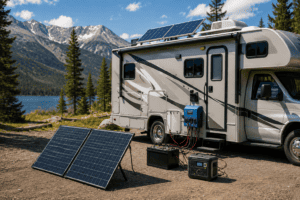
- Use public land when it fits. A seasonal BLM permit costs a fraction of a resort, and a solar setup makes life without hookups (campsite power, water and sewer connections) more comfortable.
- Pick memberships you will use. A membership only saves money if your route passes enough of its locations.
- Match your internet plan to your data. If you do not stream heavily, a smaller Roam plan costs a fraction of Unlimited.
- Shop health coverage by state. Compare premiums in each domicile state you are considering before you choose one.
Pros
- Monthly park rates and public land permits cost far less than nightly stays
- No house property tax or home utility bills if you sell, though some parks bill electricity separately
- You control the budget by choosing when and how far to move
Cons
- Nightly campground fees add up fast
- Fuel is expensive for large, low-mpg motorhomes
- Repairs arrive without warning
- Health insurance if you are under 65 without employer coverage
Should you try it before you commit?
One practical way to test your budget is to live it for a few weeks first. Renting an RV for an extended trip shows you your real fuel, campsite and food costs, and whether you like the lifestyle, before you sell a house or buy a rig.
Test the lifestyle with a rental
See how renting first can save you from an expensive mistake, and what to look for on a longer trial trip.
Read rent before you buy