The best RV black tank treatment for most owners is a formaldehyde-free bacteria and enzyme product such as Unique RV Digest-It, dosed after every dump and backed by plenty of water. Thetford AquaMAX Toss-Ins is the drop-in option, and Happy Campers is the mineral-based choice if you would rather skip enzymes.
What is a black tank?
A black tank is the holding tank under your RV that collects everything flushed down the toilet. Sinks and showers usually drain to a separate gray tank, though some floor plans send the bathroom sink to the black tank. Waste stays in the black tank until you empty it at a dump station or sewer hookup.
That storage role is the whole problem. A black tank holds waste for several days and is not a mini septic tank, so nothing gets treated the way it would in a home system.
A treatment has two jobs: control odor and keep solids and toilet paper loose enough to leave when you dump. It does not replace water, which matters more than any bottle you can buy.
Enzyme and bacteria vs chemical treatments vs deodorizers
Tank products fall into four rough groups, and the label does not always make the difference obvious. Check how a product claims to work before you look at the scent or the size.
| Type | How it works | Typical ingredients | Septic and dump station fit |
|---|---|---|---|
| Enzyme and bacteria | Speeds the natural breakdown of waste and paper | Enzymes, plus Bacillus, a group of bacteria | The type to favor for septic systems |
| Chemical (biocide, a substance that kills or slows microbes) | Kills or slows bacteria, or reacts with odor compounds | Formaldehyde, bronopol (a bacterial pesticide), glutaraldehyde (embalming fluid), quaternary ammonium compounds (germ-killing chemicals) | Poor; can harm septic systems |
| Mineral | Marketed as working without enzymes or biological action | Minerals and micronutrients | Happy Campers lists its formula as septic-safe |
| Deodorizer or fragrance | Masks smell | Scents, often added to the types above | Depends on what else is in the bottle |
Fragrance does part of the work in these products. Thetford adds it to AquaMAX to mask remaining odors, and Digest-It lists a fragrance too, so a pleasant scent tells you little about whether a product is doing the real work.
Chemical products are sold for harsh conditions, and Thetford markets Aqua-Kem for extreme temperatures. Heat is the weak spot for biological products, and Thetford and Unique both call for extra treatment in hot weather. Biological products have also historically been less popular because of reliability and cost.
Thetford’s Aqua-Kem Toss-Ins are a clear example of the chemical side, with a bronopol-based formula. We left formaldehyde and bronopol products out of our picks because of what comes next.
Why formaldehyde matters at dump stations and septic systems
EPA classifies formaldehyde as carcinogenic to humans when inhaled. For most RV owners, the bigger practical issue is what these chemicals do downstream.
Septic systems depend on bacteria. When formaldehyde and similar chemicals reach a septic tank, they can kill that bacteria, so solids move on to clog the drainfield, the buried soil area that finishes treating the wastewater. Inadequately treated sewage can then reach the surface or groundwater.
Holding tank waste is already a hard load. A 2000 Bureau of Land Management note, based on its author’s experience and not peer reviewed, put the mix with most formaldehyde-based deodorizers at 15 to 20 times the organic strength of typical household wastewater, and said treatment systems were often undersized for that load.
Do not assume a dump station can take anything.
Some stations feed onsite systems rather than a city sewer, and operators can restrict what goes in. A dump station or park whose system causes contamination may be forced to close until the problem is corrected.
Regulators have gone further in places:
- Washington: State health guidance tells RV park operators not to sell tank products containing formaldehyde, bronopol, glutaraldehyde and a longer list of chemicals. It also asks them to encourage owners to use no chemicals at all and to dump at facilities connected to a municipal treatment plant.
- California: Since January 1, 2022, state law has made it unlawful to sell RV holding tank products containing formaldehyde, bronopol or 12 other listed chemicals, or to use them in an RV holding tank. Campgrounds on septic systems must also post a notice. Enforcement is contingent on the Legislature providing funding.
Read past the words “formaldehyde free.” Bronopol is a bacterial pesticide that breaks down into formaldehyde, and the word “biodegradable” does not by itself mean a product is safe for a septic system.
Our top RV black tank treatment picks
All three picks are claimed by their makers to be free of formaldehyde and bronopol, and they cover liquid, drop-in and powder formats. The table shows what each maker publishes.
| Product | Type | Maker’s dose | Formaldehyde and bronopol | Septic claim |
|---|---|---|---|---|
| Unique RV Digest-It | Bacteria and enzymes, liquid | 2 ounces per dump for tanks up to 40 gallons (4 ounces for the first treatment), 4 ounces up to 80 gallons, 6 ounces up to 120 gallons | None, per maker | “Septic safe” |
| Thetford AquaMAX Toss-Ins | Enzyme-based, drop-in packet | One 1.5-ounce packet per 40 gallons | None, per maker | None found on Thetford’s RV pages |
| Happy Campers | Mineral-based, powder | One scoop per 40 gallons | None, per maker | “Septic-safe” |

Unique RV Digest-It Holding Tank Treatment
Unique publishes its ingredient list, including four enzymes and viable Bacillus bacteria, the most detail among our three picks. The list also includes isothiazolinones, antimicrobial compounds often used to preserve cleaners and detergents. They are not on Washington’s or California’s lists. Comes in a 32-ounce bottle that gives 16 treatments at the smallest dose.

Thetford AquaMAX Toss-Ins
Water-soluble, pre-measured enzyme packets from the maker of the Aqua-Magic RV toilet. A good fit if you hate measuring liquid into a toilet. The listing we link is a 30-count pack. Thetford’s own page shows a 16-pack bag.

Happy Campers RV Holding Tank Treatment
Marketed as working without enzymes, and works in black and gray tanks. Its maker publishes a long list of chemicals the formula leaves out, and one container gives up to 64 treatments.
Camco’s TST line is widely sold. We left it off because we could not confirm its ingredient claims on a Camco page, not because of a problem with the product.
Not worth paying for: A fancier scent. If your tank smells, try more water and a thorough rinse before you buy a pricier bottle.
How to use a black tank treatment
The routine takes a couple of minutes at each dump, and the order matters. This sequence draws on Unique’s instructions and standard dump station practice, so always check the label of the product you buy. Wear waterproof gloves at the dump station, and wash your hands with soap and water when you finish.
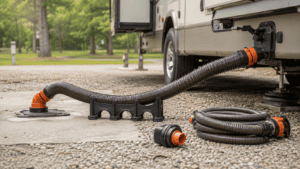
- Dump and rinse. Empty the black tank and rinse it clean, then empty the gray tank, which helps clear the hose. A solid connection helps here, so see our best RV sewer hose guide if yours is leaking or cracked.
- Close the black valve. It stays closed until the next dump.
- Add water first. Unique’s instructions call for 3 to 5 gallons at full hookups (a site with electric, water and sewer connections), though its Black Tank Guidelines page says 2 to 4. Its dry camping routine, written for its powder and drop-ins, calls for 5 to 7 gallons before a trip.
- Dose through the toilet. Fill the bowl halfway with water, add the treatment and flush.
- Give it time. Thetford’s guidance for enzyme products is that they can take up to 24 hours to reach full effect, so dose before you leave for a trip when you can.
- Repeat after every dump. Unique’s routine calls for a fresh dose each time.
Label directions come first. Thetford’s FAQ allows going above its recommended dose, but too much of any treatment can disrupt a septic system. Dumping more often reduces how much you need.
Switching from a chemical product
Do not expect an enzyme treatment to work right away after a chemical one. Thetford’s guidance is that chemical residue can reduce the performance of enzyme products, so clean the tank before you make the switch.
Hot and cold weather
Heat is the toughest case for any treatment. If the tank may be over 85°F, Unique advises more water with every flush and a double dose. Thetford notes extreme heat and longer holding times may need extra treatment too.
Thetford’s guidance for its enzyme products is that they slow down in the cold, so do not count on them in a cold tank. Never store your RV with a full holding tank when temperatures may drop below freezing, and follow our RV winterizing guide before storage.
Basic black tank habits that prevent most problems
Good habits do more than any product on this page. The treatment only helps if the tank has enough water to work in.
- Keep water in the tank: Treatment bacteria need water to survive and reach waste, and water softens solids before they compact.
- Use more water per flush: Hold the pedal for at least 10 seconds, and keep a little water in the bowl to help block odors.
- Keep the black valve closed: Do this even at full hookups. An open valve can leave a pyramid of solids under the toilet.
- Dump at half full or more: Plan on emptying the tank every 3 to 5 days.
- Use the right paper: Flush only water, bodily waste and rapid-dissolving toilet tissue.
- Keep bleach out: Chlorine and caustic drain products damage toilet seals and plumbing valves, and bleach should never be used to “sweeten” a tank.
- Check the vent: A working ventilation system helps reduce odors.
New to all of this? Our beginner RV accessories guide covers the rest of the gear you will want for dump day.
How do you clean an RV black tank?
Routine RV black tank cleaning is mostly rinsing. Use a tank flushing device after each dump, or fill the tank with water and dump it again. If there is a line behind you at the dump station, save the extra rinse, since it is considered poor etiquette.
Keep a separate hose for rinsing, and never use your drinking water hose for it. If your RV has a built-in black tank flush, keep the black valve open while it runs and follow your owner’s manual.
A deep clean is a soak. Shut off any built-in flush, close the valve, and fill the tank as far as you can without overfilling it, using a method your owner’s manual allows. Stay with the hose while it fills, add a tank cleaner, follow its label and let it sit. Then dump and rinse twice.
Unique suggests a deep clean at least twice a year for weekend campers and every 60 days for stationary RVs. For full-timers, its deep clean guide says every 10 dumps, while its Black Tank Guidelines page says every 4 to 6 months. Browse more options in our RV gear guides.
Sources
Researched from manufacturer pages, government documents and university extension material, opened November 2026.
Thetford: Thetford US home page · Which holding tank treatment should I use? · Aqua MAX Toss-Ins · Aqua MAX Liquid · Aqua-Kem Toss-Ins · How does Aqua MAX treat the waste? · How to prepare your RV waste tank for enzyme treatments · Aqua-Magic VI
Unique Camping + Marine: RV Digest-It Holding Tank Treatment · Treating your RV holding tanks · Black tank guidelines · Why using lots of water is crucial · How to deep clean RV black water holding tanks · Product instructions
Happy Campers: RV Holding Tank Treatment, 64 treatments · FAQs
U.S. EPA: IRIS formaldehyde assessment · Do Not Use Chemicals Which Harm Septic Systems
Regulations.gov: EPA MIT and CMIT risk assessment
Bureau of Land Management: Dealing With Holding Tank Wastes at BLM Sites
University of Arizona Cooperative Extension: RV Holding-tank Treatments and Deodorizers in Septic Systems
Washington State Department of Health: RV Parks: Large On-site Sewage Systems Best Management Practices
California Legislative Information: Senate Bill 317
FindLaw: California Health and Safety Code 25210.2
LegiScan: Senate Bill 317, chaptered text
Winnebago: Beginner guide to RV toilets and dump station tips
Escapees: What Does Full Hookup Mean at an RV Park?
Dometic: 310 Series toilet manual
ManualsLib: Fleetwood Bounder owner’s manual, black tank flush · Jayco Seneca owner’s manual, plumbing
City of Murfreesboro: Septic System
Los Angeles County Public Health: RVs as temporary use housing
U.S. CDC: Protecting workers handling human waste