An RV surge protector is the cheapest insurance you can buy for the most expensive systems in your rig. Campground power is often miswired or unstable, and one bad pedestal can fry your air conditioner, converter, or fridge in seconds. Here is what actually protects you, and the units worth buying.
Plugging into shore power feels routine, but the pedestal you connect to at a campground is a wildcard. It might be wired wrong, worn out, or sagging under the load of a hot summer afternoon when every rig on the loop is running air conditioning. Any of those can quietly destroy thousands of dollars of onboard electronics.
A good protector watches the power and cuts it off before that happens. The key is buying the right kind.
Surge protector vs EMS: What is the difference?
They look similar and plug in the same way, but they do different jobs.
- A basic surge protector only absorbs voltage spikes, like a lightning-related surge. It does nothing about the wiring faults and voltage problems that cause most RV electrical damage. These run about $60 to $110.
- An EMS does everything a surge protector does, then adds the protection that matters: It checks the pedestal for miswiring before it lets power through, and it constantly watches voltage, cutting off automatically if the power drops too low or spikes too high. This is what saves air conditioners and converters. Expect roughly $110 to $340 depending on amperage and features.
The price gap is real, but so is the risk. A new RV air conditioner runs $800 or more installed, so an EMS pays for itself the first time it catches a bad pedestal.
30 amp or 50 amp: Match your rig
Buy the one that matches your RV’s shore power cord, not the other way around. A smaller trailer or camper van is almost always 30 amp (a three-prong plug). A larger motorhome or fifth wheel with two air conditioners is usually 50 amp (a four-prong plug). If you are not sure, check your cord’s plug or your owner’s manual. Fifty-amp units cost more and carry higher joule ratings, but the right choice is simply the one that fits your rig.
Our picks
Hughes Power Watchdog (portable EMS)
Full EMS with a phone app that shows you the voltage in real time, plus a replaceable surge module, so one big hit does not mean buying a whole new unit. About 3,000 joules of surge protection. Around $150 for 30 amp, $320 for 50 amp.
Progressive Industries EMS-PT30X / EMS-PT50X
The reliability standard, in a rugged weatherproof housing with a lifetime warranty. No app, but it does the core job as well as anything. Around $110 for 30 amp, $250 for 50 amp.
Progressive Industries EMS-HW30C / EMS-HW50C
Installed inside your rig, so it cannot be stolen off the pedestal or left out in the rain. Same protection, with an optional in-cabin display. Around $210 to $320 depending on amperage.
Camco basic surge protector
Cheap and better than nothing, but it is a surge protector, not an EMS, so it will not catch bad wiring or voltage problems. Fine as a backup, not as your main protection. Around $60 to $110.
How they compare
| Model | Type | Joules | Approx price | Best for |
|---|---|---|---|---|
| Hughes Power Watchdog | Portable EMS, app | 3,000+ | $150 to $330 | Most people who want the best protection and monitoring. |
| Progressive EMS-PT30X / 50X | Portable EMS | 1,790 / 3,580 | $110 to $250 | The best value, with a lifetime warranty. |
| Progressive EMS-HW30C / 50C | Hardwired EMS | 1,790 / 3,580 | $210 to $320 | Theft-proof, weatherproof, permanent. |
| Southwire Surge Guard | Portable EMS | 2,100 / 4,200 | $150 to $300 | A strong alternative with high joule ratings. |
| Hughes Autoformer | EMS plus voltage boost | 2,400 / 4,800 | $400 and up | Sites with chronically low voltage. |
| Camco surge protector | Surge only | Varies | $60 to $110 | A cheap backup, not full protection. |
Joules are shown as the 30-amp and 50-amp ratings where they differ. Higher joules absorb a bigger surge, but all the EMS units above also protect against the voltage sags and wiring faults that cause most RV electrical damage.
One step up: A voltage-boosting autoformer
There is one problem an EMS does not solve. When you camp somewhere with chronically weak power, a crowded park on a hot afternoon, or a long run of extension cord, the voltage can sag below the safe threshold. A good EMS responds by cutting the power off to protect your rig, which keeps your electronics safe but also shuts your air conditioning down right when you need it most.
An autoformer handles it differently. Instead of just disconnecting, it actively boosts low voltage back up to a usable level, so you keep running. The Hughes Autoformer line does this and includes full EMS protection on top. The trade-offs are real: It is heavier, it costs more (roughly $400 and up), and most campers do not need it. But if you regularly stay where the power is weak, this is the reason to spend more.
Hughes Autoformer (EMS plus voltage boost)
Full EMS protection plus active voltage boosting, so your air conditioning keeps running when the pedestal sags. Overkill for most, essential for some. Around $400 and up.
Portable or hardwired?
Both protect the same way. The difference is where the unit lives.
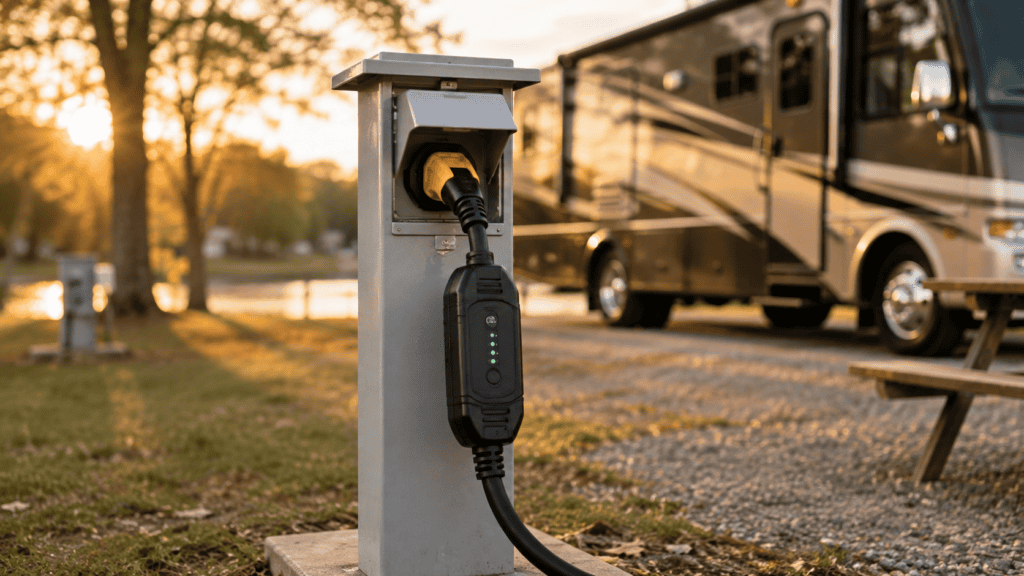
- Portable: Plugs into the pedestal at the campsite. Easy, moves between rigs, and lets you read its display right at the post. The downsides: It sits out in the weather, and it can be stolen, so use the built-in lock loop and a padlock.
- Hardwired: Installed inside your RV between the cord and the panel. It cannot be stolen or rained on, and many show status on an in-cabin display. The trade-off is a one-time install, which is straightforward but is a project.
How to use it
- Turn the pedestal breaker off Always kill the power at the post before you plug or unplug anything.
- Plug the protector into the pedestal Then connect your RV cord to the protector.
- Switch the breaker on and wait An EMS runs a diagnostic for a couple of minutes and checks the wiring before it passes power through. If it finds a fault, it will not turn on, which means it just saved you.
- Lock a portable unit to the pedestal Run a padlock or cable through the lock loop so it does not walk off overnight.
The bottom line
Do not skip this, and do not buy a bare surge protector and call it done. For most people, the Hughes Power Watchdog is the best pick, a full EMS with real-time monitoring and a replaceable module. If you want to spend less, the Progressive Industries EMS-PT gives you the same core protection and a lifetime warranty. Buy the amperage that matches your rig, lock it up at the pedestal, and let it do its job. It is the single best few hundred dollars you can spend to protect everything else in your RV.
Just getting set up? See our full RV gear guide for the rest of the first-trip essentials.